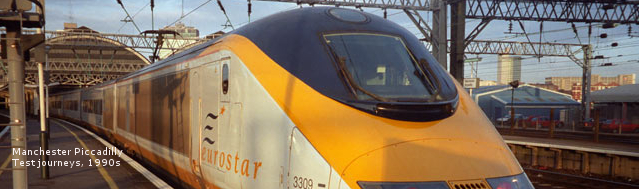
Politicians have a key role of in pushing forward the rail possibilities of urban regeneration. The best can be the intelligent client, the leader in more than title, whereas too many will only have a short term view.
In the public perception of city governance the two issues of transport and crime are probably the key defining characteristics of a city and therefore also of its mayor or leader.
In terms of taking a long term view, transport infrastructure can shape a city for centuries to come. Consider the city and its river or port: trade relied on boats for many centuries before roads and wheeled transport. The city often started where the river was just narrow enough to cross and just wide enough to sail away. Roads, canals, railways and airports have all since both shaped and grown cities.
At the UK level for rail, the politician many would regard as the intelligent client of recent years would be Lord Andrew Adonis. He constructed a cross-party consensus for rail investment, and not just for high profile projects such as HS2 but also the mundane but essential task of rail electrification. Unlike some of other ministers he started with a vision rather than a spreadsheet. Putting electric wires above the track makes sense for so many reasons (pollution, climate change, faster journeys, further destinations, reliability, cost). But some previous transport ministers even felt proud in justifying their department having no investment plans for further electrification.
And having a capable transport minister at the national level helps politicians at the city level, especially cities outside London, to take their city vision forward.
London has its own legal powers to organise transport that are denied to other UK cities, and historically has had a first call on national rail funds for grand projets such as ThamesLink (north-south), CrossRail (east-west) and HS1 (international).
City-regions such as Greater Manchester have led the way in “pushing the envelope” of rail development and urban renewal, with both tram and train, by using political soft power to make up for hard legal powers.
Somewhere there is a political book to be written on, the Association of Greater Manchester Authorities (AGMA), public (mass transit) transport and urban regeneration and renewal from bus deregulation in 1980s to Metrolink and HS2 in 21st century. The lessons would be enormous, in my view.
Category Archives: Uncategorized
Desert Island Shops
Sir Terry Leahy has said that the closure of small, independent shops on the High Street is “part of progress”, that some High Streets are “medieval” (is this bad?), and that out-of-town shopping malls and supermarkets are the way forward.
The former Chief Executive of Tesco was speaking on the BBC radio programme, Desert Island Discs.
He has also endowed the University of Manchester with a Centre for Sustainable Consumption.
Commercial property owners, and the pension funds behind them, will not be happy with the “silver lining” comment that shop closures will help with falling rents. All in all, a good case study for urbanists of dismal development. Link:
http://m.bbc.co.uk/news/uk-21310808
Mental Health: hearing voices and recovery
Recently I’ve been pleased to be back in touch with all old friend from university days, Paul Baker.
Hearing voices can be very distressing, but some of the drug based treatments can shorted life by up to 20 years. Paul has worked tirelessly since the 1980s on other options, developing support groups for people who hear voices, along with their families and friends; all around coping and recovery from distress.
Paul is also involved in a range of radical mental health groups, including the international Hearing Voices Network which, from when he started, now involves 28 countries around the world.
I hope I can be of some assistance to this area of work, and if you are interested in these approaches to mental health even in extreme circumstances then these links may help. Links:
1. International Centre for Recovery Action – http://www.icra-wholelife.org 2. Recovery, Hearing Voices and Well-being – http://www.workingtorecovery.co.uk 3. Hearing Voices Network – http://www.hearing-voices.org
4. The various support groups also use FaceBook in significant numbers.
Urban Regeneration and Rail, part 2
Previously: urban regeneration and rail development is more than increased land values next to new stations (taxed by the Community Infrastructure Levy) and lower land values next to new track (paid from taxes as compensation). What else can we consider?
One aspect which receives some attention in textbooks is the conflict within rail systems between local stopping trains and long-distance services. As an example from Manchester, the long-closed rail station at Longsight and the barely-open station at Ardwick are both on key routes for long-distance trains. The reasons for a station closure are rarely simple, but the pressure for long-distance services adds to the reasons to reduce or end local services. And these pressures are often highest within the inner city ‘doughnut’ surrounding the city centre and each rail terminus, thereby removing these inner communities from the connectivity benefits held by suburbs and commuter towns further out. Curiously, a rural station may be closed because there are too few passing trains; whereas an inner-city station may be closed because there are too many trains wanting to pass.
Equally the new ‘Northern Hub’ programme of rail improvement projects is a good example of how to improve local rail services because the new layouts will separate train routes which are currently in conflict. Local politicians have especially noted that significant local service improvements should be possible within north Manchester, a disadvantaged quarter of the city.
There are also light-rail or tram systems, such as the expanding Metrolink network in Greater Manchester, which provide a local rail service with greater access to urban centres by running on-street as well as on segregated track (usually previously used for heavy-rail).
It is a matter of public policy to direct or ‘bend’ these light and heavy rail urban developments towards re-connecting disadvantaged areas – serving the poorer areas that commercial services would otherwise just rush past. The skill or craft in implementing this public policy direction is an area to be explored next.
Urban regeneration and Rail, part 1
I’m starting here what I hope might become a mini-series on rail and urban regeneration.
Hope? Well, a bit of me thinks that it will already be written, in books or online: the obvious that needs no introduction.
But another part of me thinks it still needs to be spelt out. I am especially disappointed every time I see the phrase ‘regeneration’ used in connection with a new railway line or station, when they really mean ‘increased land values nearby’. Especially when they own that land.
The connection between increased land values and railway developments has been known since the 1800s. There is an argument that the early Victorian railway companies were about land ownership as much as they were about transport. Perhaps the best example is ‘Metroland’ in north west London with the growth of suburbia along the Metropolitan Railway Company’s new line, all skilfully planned and marketed, as later brilliantly captured in poetry by John Betjeman.
However, 130 years ago and more in prose than in poetry, there was the Cheap Trains Act 1883 which helped the London County Council in particular move working families out of the filthy inner slums, reinforced by the Housing of the Working Classes Act 1890. These developments are covered in the main textbooks for students of urban geography, but it seems to me only as a period in time ending in the 1930s when suburban development was still an area of rapid growth.
The next post will be to explore what rail can do for urban regeneration in the 21st century.
EU reforms may include EU regional policy
The idea of an EU referendum is politically divisive, but all sides support EU funding reform. EU regional policy and funds look set to change, but what might these changes look like?
This month the UK Prime Minister has set out how an EU referendum might happen around 2018; and the Labour Party front bench has made media comments on their agreement in the UK seeking reforms of EU regional policy including the EU structural and cohesion funds (SCF).
This could be the policy pendulum swinging back to the 1970s.
Prior to being outlawed in 1988 in the UK there was quite a move, especially within local government, to promote ‘contract compliance’ by which progressive and anti-discrimination practices could be written into taxpayer-funded contracts.
And prior to 1992 it was possible for countries in the EU to operate regional and industrial ‘preference schemes’ to channel aid to areas and industries in or at risk of decline. The politics of the 1980s reduced and then ended these ‘state aid’ schemes, characterised as ‘lame ducks’. More recently, the former EU Commissioner and UK politician Peter Mandelson noted wryly: ‘these schemes were less about governments choosing failing businesses, and more about failing businesses choosing government support’.
Over time the EU single market law took a deeper hold and any forms of local protection became outlawed, to be replaced by grants and loans through the new SCFs run by the EU. These new funds were also improved: projects were bundled together into five-year programmes with devolved administation, avoiding (it was hoped) the Brussels bottleneck.
Maybe some or all of these changes from the 1980s will now form part of the EU reform negotiations. It is an open secret that the UK Treasury does not like the SCFs, seeing it as an inefficient way to be paid back around 60% of the UK’s financial contribution to the EU, and with strings attached. However, local politicians like the SCFs for the same reason, that it provides a significant pot of money which the Treasury cannot confiscate.
So much of the public debate has been about the quality of the activities funded by the EU through these SCFs such as the European Social Fund (ESF) and the European Regional Development Fund (ERDF). The Open Europe organisation, not the EU’s greatest fan, published its view in a booklet in 2007: ‘Why the EU should not run regional policy’ which included anecdotes such as:
‘In the South East an ESF grant was given to a “cafe van”, whose owner is meant to tour the country for the purpose of teaching builders about sustainable development. (Building, 27 Oct 2006)’ which by the Executive Summary had become a burger van for builders. To be fair, the booklet also makes some more measured points on the limitations of the chosen method of economic statistics in targeting funds on the most deprived areas.
Where next?
The very topic of regional policy was an anathema to the Coalition Government in 2010, though the increasing North-South gap and the lack of growth are becoming more politically visible as time passes. The report on enabling regional growth by Lord Heseltine has become a rallying point for many politicians north of London, of the left and centre if not the more neoliberal right.
So perhaps the next stage is a reform at the EU level of competition policy within the single market, to allow again for subsidies in areas of greatest need. EU competition policy assumes a level playing field which it preserves by law; it is useless when the field is built on a steep hill and the poorer regions are forced to play uphill. A new regional remedy may be part of the reforms. Lord Hesletine has spoken in favour of the French system of compulsory membership for businesses in their local chamber of commerce. He may also like the French ‘Colbertist’ culture of strategic state subsidies too.
Are we over-constructing our buildings?
This Monday (28 January) the UK’s BBC Radio 4 Today news programme included an interview suggesting that the UK construction industry regularly uses too much material in making a modern building.
Dr Julian Allwood, at Cambridge University, was speaking about his new report on how we use too much material when we make stuff, including buildings. He suggested that one reason is that staff time is expensive when compared with the cost of materials, so shortcuts are made at the design stage by adding in extra construction materials ‘just in case’ rather than taking the time needed to design the building in a more efficient way. He also questioned why new buildings are expected to last 200 years when the evidence suggests that they will only last 40 years before being demolished and replaced.
One question, at least in the public sector which accounts for 40% of UK construction, is whether the new UK requirement to include Building Information Modelling (BIM) processes from the design stage onwards will help achieve the efficiency savings in the whole life costs (WLC) of a new building.
Links:
BBC Radio 4, 28 January 2013
07.23am “Dr Julian Allwood,(www.lcmp.eng.cam.ac.uk/welcome/people/julian-m-allwood) from Cambridge University, explains a report that he authored that says industries must radically cut the amount of materials they use to combat resource shortages and climate change.” www.bbc.co.uk/news/uk-21227152
Cambridge University
“The Low Carbon and Materials Processing group is a research group within the Department of Engineering at the University of Cambridge. Our work [includes how] … engineering can contribute to a low carbon future, particularly through reduced energy demand in industry.” www.lcmp.eng.cam.ac.uk/welcome/introduction
Social Value, the latest addition to public procurement in construction
This month sees the start of a new law in UK public procurement. The Public Services (Social Value) Act 2012 was passed in March 2012 and started to take effect in January 2013. This law applies to public bodies in England, and some in Wales. In summary it makes possible for all authorities to follow the best practice that has already been implemented by a few in using their procurement processes to better promote the well-being of their local communities.
One example of how this might work is given by Social Enterprises UK as follows:
“A housing Arms Length Management Organisation (ALMO) contracts a private sector company to undertake repair work on their properties. As part of the contract the private company states that they will provide greater social value by promoting careers in construction and trades to local schools, and they commit to employing young people and the long term unemployed. The social value comes through local jobs for local people and raising the aspirations of local pupils.”
The local authority must, as before, only accept the most economic advantageous tender. What this Act confirms is that the previous practice of ‘social considerations’ can be part of the public procurement process provided that any social considerations are (1) included in the list of various selection criteria in the call for tenders; (2) not used to exclude any bidding organisation from being scored, even if the social value element of their score is zero; and (3) can have their performance measured in an objective manner; and (4) do not disadvantage any bidder from an organisations anywhere in the EU.
The four requirements above are sometimes known as ‘local performance criteria’. This means that a tender must be open to any competent enterprise based anywhere in the EU to apply and have their tender considered fairly, but that it is possible to specify that, wherever they may be based, the local impact of the service is X. One common example is that the provision is based in a local office. Another example, more likely now, is that the provider must engage with a local Young Offenders Institution.
Further reading:
www.socialenterprise.org.uk/policy-campaigns/campaigns/social-value
Regional Growth Fund: a checklist
There have been significant difficulties in the RGF processes for Rounds 1 to 3, including reports of approved-but-later-withdrawn projects because of compliance and due diligence issues post-approval. The causes of these difficulties are partly due to the lead applicant having to be a private sector company.
– For SMEs only, using supply chain clusters and open-door events so that the project passes due diligence for State Aid compliance;
– Focus on areas of highest worklessness;
– Lead application to run the project office at cost, open book;
– Possible public sector delivery partner/s who could later enhance project with an ERDF bid, because systems are already compliant for State Aids, procurement, publicity, etc;
– Need to quantify jobs created and safeguarded; and
– Need to quantify the capital plant investments aligned to the project’s growth.
Round 4 bids, minimum bid is £1m, deadline is 12:00, 20 March 2013. Free booklet on compliance etc available on request, sae or pdf.
City centre living for active older people
In the field of urban regeneration there are discussions about sustainable future uses for some city-centre apartment schemes. In the last five years the growth in student renting as a niche market has been helpful, and this note is to suggest that a similar niche market could be developed for older active people, with some outline thoughts as follows, using the Castlefield area in Manchester as a Case Study to explore ideas.
Locational Benefits
Castlefield is often used as a film set, being an urban quarter with sensitive, historic and strategic features including Roman and industrial revolution connections. It has a complex canal waterfront, monumental transport viaducts, a YHA café, YMCA fitness centre and pool, a major museum nearby plus the city centre core within walking distance. Nearby there are the Concert Hall, the Art Gallery, the Royal Exchange and other theatres, plus Deansgate and King Street for premier shopping and the usual range of ‘metro’ supermarkets, as well as the whole range of city centre activities.
There could well be an opportunity in locations such as this to be re-marketed with developments aimed at aspirational retired professionals looking to downsize, to let go of the car or drive less often (cars can be hired by the hour now), and to relocate their home in order to easily maintain their access to the prime leisure and cultural offers of the city centre while living in a quieter urban quarter with a waterfront or similar advantages. The fact that some developments are currently stalled or only built to shell allows for a re-thinking of some of the internal features. People with retirement income can be less affected by a recession, with their purchasing power no longer dependent on their (previous) employment.
Design Benefits
The internal fit-out could well be informed by the Lifetime Homes standards, and all apartments with two or more bedrooms. This might involve costs in changed designs and drawings, but the marketability will be worth the effort, as well as keeping a work flow for in-house design teams. Some planners suggest that more amenity space would also be attractive to older purchasers. There is sometimes adjacent underused land (such as empty light industrial and former car showrooms) which might make well-designed public and/or private open space.
The benefits of active frontages at the ground level are well documented, and with goo design a mix of small general retail plus health care could be attractive and viable. Many city centres still need to build up the social infrastructure of GP or nurse-lead health services, and a mix of commercial and non-commercial income may make such frontages more viable.
Facility Management
Important features for prospective purchasers could include:
- covenanted limits on occupation, use and transfer
- visible, proactive and reassuring property management with a concierge service
- acceptance of usual non-threatening companion pets even though apartments.
Initial Feedback
Since first circulating a version of this note in October 2009, feedback from a private sector letting perspective has identified a current barrier in the inability currently for home-owners to sell their existing properties in order to finance such a move.
Therefore, there may be a need to include with the discussions people from a financing background. The requirement would be for one or more financing organisations which has a trusted and ethical brand to be included, in order to provide a wrap-around service which could include the following options:
- Selling
- Immediate open-market sale of suburban property and purchase or rental of city centre property, with (if needed) post-employment residual mortgages based on retirement income
- Delayed open-market sale of suburban property (achieved by an immediate sale to a financial institution for a fair price as an ethical equity release) and purchase or rental of city centre property
- Renting
- Managed rental of suburban property and income used for rental (or purchase) of city centre property, based on guaranteed minimum payments, with the asset retained
- Lifetime-of-couple rental and service charges of city centre property paid in a lump sum on moving in, based on actuarial tables
- Renting funded from retirement state benefits (but being aware of proposed changes to Housing Benefit limits).
First published: 09 August 2010
