Recently I’ve been pleased to be back in touch with all old friend from university days, Paul Baker.
Hearing voices can be very distressing, but some of the drug based treatments can shorted life by up to 20 years. Paul has worked tirelessly since the 1980s on other options, developing support groups for people who hear voices, along with their families and friends; all around coping and recovery from distress.
Paul is also involved in a range of radical mental health groups, including the international Hearing Voices Network which, from when he started, now involves 28 countries around the world.
I hope I can be of some assistance to this area of work, and if you are interested in these approaches to mental health even in extreme circumstances then these links may help. Links:
1. International Centre for Recovery Action – http://www.icra-wholelife.org 2. Recovery, Hearing Voices and Well-being – http://www.workingtorecovery.co.uk 3. Hearing Voices Network – http://www.hearing-voices.org
4. The various support groups also use FaceBook in significant numbers.
Monthly Archives: February 2013
Urban Regeneration and Rail, part 2
Previously: urban regeneration and rail development is more than increased land values next to new stations (taxed by the Community Infrastructure Levy) and lower land values next to new track (paid from taxes as compensation). What else can we consider?
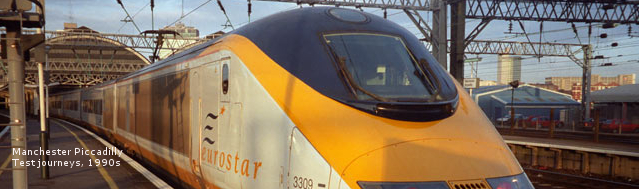
One aspect which receives some attention in textbooks is the conflict within rail systems between local stopping trains and long-distance services. As an example from Manchester, the long-closed rail station at Longsight and the barely-open station at Ardwick are both on key routes for long-distance trains. The reasons for a station closure are rarely simple, but the pressure for long-distance services adds to the reasons to reduce or end local services. And these pressures are often highest within the inner city ‘doughnut’ surrounding the city centre and each rail terminus, thereby removing these inner communities from the connectivity benefits held by suburbs and commuter towns further out. Curiously, a rural station may be closed because there are too few passing trains; whereas an inner-city station may be closed because there are too many trains wanting to pass.
Equally the new ‘Northern Hub’ programme of rail improvement projects is a good example of how to improve local rail services because the new layouts will separate train routes which are currently in conflict. Local politicians have especially noted that significant local service improvements should be possible within north Manchester, a disadvantaged quarter of the city.
There are also light-rail or tram systems, such as the expanding Metrolink network in Greater Manchester, which provide a local rail service with greater access to urban centres by running on-street as well as on segregated track (usually previously used for heavy-rail).
It is a matter of public policy to direct or ‘bend’ these light and heavy rail urban developments towards re-connecting disadvantaged areas – serving the poorer areas that commercial services would otherwise just rush past. The skill or craft in implementing this public policy direction is an area to be explored next.
Urban regeneration and Rail, part 1
I’m starting here what I hope might become a mini-series on rail and urban regeneration.
Hope? Well, a bit of me thinks that it will already be written, in books or online: the obvious that needs no introduction.
But another part of me thinks it still needs to be spelt out. I am especially disappointed every time I see the phrase ‘regeneration’ used in connection with a new railway line or station, when they really mean ‘increased land values nearby’. Especially when they own that land.
The connection between increased land values and railway developments has been known since the 1800s. There is an argument that the early Victorian railway companies were about land ownership as much as they were about transport. Perhaps the best example is ‘Metroland’ in north west London with the growth of suburbia along the Metropolitan Railway Company’s new line, all skilfully planned and marketed, as later brilliantly captured in poetry by John Betjeman.
However, 130 years ago and more in prose than in poetry, there was the Cheap Trains Act 1883 which helped the London County Council in particular move working families out of the filthy inner slums, reinforced by the Housing of the Working Classes Act 1890. These developments are covered in the main textbooks for students of urban geography, but it seems to me only as a period in time ending in the 1930s when suburban development was still an area of rapid growth.
The next post will be to explore what rail can do for urban regeneration in the 21st century.
