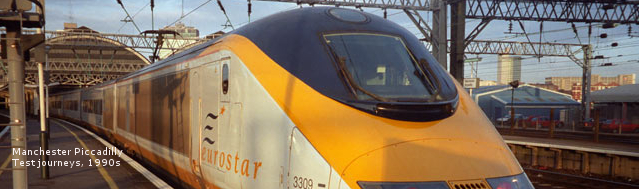
Night Trains being cut across the EU

This month the German train operator DB announced it is cutting many night train services including from Copenhagen to Prague, and from Paris to Berlin. I have been campaigning for a night train between Manchester and Paris.

Katie Mitchell wrote about these changes in The Guardian on 18 September 2014, and the “huge blow” this is to people like her who regularly use night trains. She has given up air travel in favour of trains, but still needs to get to her work in different European cities without extra days of travelling.

Her article attracted 328 comments, which I read to distill the essence of these changes to night trains. Of course, it is necessary to filter out a sadly large number of comments which are plain abusive and those just pumping oil. From the sensible comments the key factors at the moment seem to be:

1. The German government has recently allowed long-distance overnight buses to start operating, and there is a cut-price market here while rival companies try to build up their market share and drive out competitors.

2. The EU transport rules forbid any government from subsidising international train services, though governments can subsidise services that only run within their borders.

3. Governments can subsidise air travel by absorbing certain general costs such as security, air traffic control, fuel duty exemptions, and airport infrastructures.

4. The growth in night freight trains has begun to crowd out night passenger trains, including new rules where some long tunnels cannot be used by a mix of freight and passenger trains at the same time.

5. The growth of high-speed rail services between EU cities has made some previously overnight services viable during the day; however this change has not been synchronised with extending the ‘reach’ of overnight services to other cities further apart.

Number two, the EU prohibition of subsiding international train services, seems particularly harsh given the subsidies (investments) that are permitted for road and air travel. It rather feels like living in the USA early last century when the car companies tried to kill support for public transport or mass transit.

We need a more thoughtful, modern and effective EU rule for international rail.

More papers for the Disability Studies Archive at Leeds University

Recently three archive boxes of papers from the files of Kevin Hyett (1958-2004) were added to the Disability Studies Archive at the University of Leeds, known as the Leeds Archive. The placing of these papers within the archive will ensure their safekeeping and their availability to future generations of researchers and activists.

Perhaps the strongest set of papers within his files are those concerning UPIAS – the Union of Physically Impaired Against Segregation.

Some of these papers can be accessed online at — https://tonybaldwinson.wordpress.com/kevin-hyett-archive/ But not all the UPIAS papers are available online. The criteria used to decide which papers are on the web is –

What was public at the time is public now, and what was private at the time remains private now.

– “Public” papers include, for example: newsletters, minutes, agendas, reports, press cuttings, website contents.

– “Private” papers are, for example: membership forms with names and addresses, personal correspondence, membership lists, mailing lists, confidential minutes, databases.

For the UK National Archives, the rule is that private and personal data remains closed from publication for 100 years after its creation. For example, the 1921 Census papers will become publicly available in 2021.

Of particular concern here, there was the UPIAS Circular which was a private, confidential circular for the members only, and not allowed to have a wider circulation or readership. As a member, Kevin had a few editions of the circular and these are now in the Leeds Archive.

There were around 62 editions of the circular, and it would be excellent if copies of every one could be located from various attics and cupboards.

The advantage of somewhere like the Leeds Archive is that these private papers can be held in a closed or controlled archive. This means they are only available to genuine researchers, and can only be used in careful, ethical ways. For example, a researcher can read a copy to understand an issue better, but they cannot print the circular for others nor publish it online.

Are we about to repeat 1976?

Many people identify the “Winter of Discontent” in 1978/9 as the cause of the change of Government that year, leading to what might be called the neoliberal era for the next 30 years.

But perhaps we should go back further, to 1976. Dennis Healey was the Chancellor of the Exchequer. Recently looking back on his life, he was interviewed for his old college at Oxford. It is worth reading the following extract as he reflects on the mistakes at the time:

In 1976 he was forced to go to the International Monetary Fund for a loan, conditional on spending cuts and a tightening of the money supply. By this time, he recalls, “I had dropped the straightforward Keynesian view with which I had had total sympathy when I entered the Treasury.” He describes this later period at the Treasury – which also saw international factors once again impact upon his life in the form of a series of global oil shocks – as being “extremely difficult for me to cope with.” Whilst he admits to mistakes which contributed to Labour’s downfall in 1979, he is adamant that “we didn’t deserve the alternative we actually got.”

Perhaps one of the most unpopular aspects of the 1976 crisis was the high-profile cut in nurses’ pay. He said much later in life that this had been a cut too far, and that it had been unnecessary as economic matters turned out. But it set a collision course between low-paid workers and government policy which culminated in the “Winter of Discontent” a couple of years later.

We seem to be covering similar ground again. The banking crisis instead of the oil crisis, and doubts again about trying for a Keynesian bounce-back from austerity. Last time the swing in votes was from Labour to Tory; the worry is that this time it might be from Tory to UKIP.

http://www.balliol.ox.ac.uk/alumni-and-friends/floreat-domus/2007/denis-healey-an-international-life

Q. When did politics become too hard to do? A. 1992.

My suggestion here is that making significant political change happen in the UK has now, mostly, been put into the ‘too hard to do’ box. The recent Scottish referendum with its galvanised discussions – 97 per cent voter registration and 83 per cent popular vote – only puts the rest of what happens these days politically into starker relief.

Of course, some will say that a referendum isn’t ‘proper’ voting, but that is just an excuse. We are now moving into a period of constitutional change for all of the UK, but where every tiny change will now require a huge amount of effort.

We can consider that this difficulty in making change happen dates back to 1992. John Major unexpectedly won the general election and the Tories stayed in power another five years.

The Labour Party was shocked to its core.

From this unexpected defeat came the essence of New Labour. But not just the policies and the presentation; above all we need to remember and understand the discipline. Up to the mid 1980s it had been said that the secret weapon of the Conservative Party was loyalty. Even before Margaret Thatcher was deposed as leader this public unity had fractured, most notably over the European Union. In turn, New Labour became the party of loyalty.

The downside of this discipline is that it became harder to argue publicly for some change. Because to argue publicly is to invite criticism, to feed talk of splits, of factions. Of course, the arguments still happened, but behind closed doors and on mobile phones. All very presentable, and of course now discredited as spin. So we had to become good Kremlinologists if we wanted to follow political debates.

The fashionable conclusion here would be to blame the Daily Mail, a paper that I do not like at all. It is the hostile press that has closed down the possibility of talking about political options in public. Maybe. But the hostile press were only ever fair-weather ‘friends’, and their negative influence is slowly declining, being replaced by social media trolls, often organised and now sometimes funded.

So, can we make change happen?

Just to be clear, my preferred devolution option is to cities, also known as city-regions and as metro-regions, but with a nuance. I share some people’s concern that Combined Authorities are too remote from the voting citizen, but I am equally not convinced that a Boris-style metro mayor is the answer. It makes easy TV, but is poor for political engagement. We need citizen engagement or civil society to mirror any new metro party-political arrangements, and in the current climate we do not have a lot of funds for new structures.

This means revisiting the too-high number of MPs in the House of Commons, and revisiting the powers that Westminster and HM Treasury takes to itself that cities could better manage themselves.

All of Scotland is a key marginal this week

The pundits are spilling a lot of ink on the Scottish referendum due tomorrow. One of the key ‘surprises’ is the high degree of political involvement, including a 97 per cent voter registration and an expected very high turnout. This compares starkly with the years of decline in voter registration and turnout in other elections throughout the UK.

Some pundits put this general decline to a rot that started with the Poll Tax, causing many people to avoid the Electoral Roll. To this received wisdom, we can add more recently the MPs expenses scandal as a reason for people to stay away from voting, and to stay away from politics.

But perhaps a deeper reason is the modern method of politics which divides voters into safe constituencies compared with marginal constituencies. The political model focuses the fight in the ‘key marginals’, leaving the majority feeling ignored and taken for granted. The safe seats only get the minimum offer – a few leaflets and a message from the party leader.

But Scotland is not voting by constituencies, it is rightly called a popular vote – every vote counts equally. Of course, there are 57 varieties of Proportional Representation and each method has its fans. But let’s not muddy the waters – the lessons and way forward for renewal in politics itself is now clear.

How many accountants does it take to run a cafe?

And the answer is… well, read on.

If we call this an anecdote, then that would be professionally a bad thing. So let’s call it a case study.

Near where we live there is a supermarket. And this supermarket is getting a refurbishment. Some aspects seem worthwhile, such as a new cold cabinets which have doors to be more energy efficient. But then there are other ‘improvements’, and to the cafe in particular.

The ‘old’ cafe, now closed to make way for more shelving, was perhaps not the prettiest place ever built, though it had large windows and space to move around. But it was the staff that made it distinctive. The same staff team worked the cafe and kitchen, and had got to know many of the regulars. M–, an elderly and quite frail lady who would get a lift in for her regular hot dinner. R–, a direct and vocal older gentleman who was harmless if somewhat opinionated. A disabled woman with her children each weekend. An evangelical man, always in a neatly ironed tank top, who would quietly minister his small flock, one to one with an egg ‘n chips. Yes, people might linger because it was airy and the staff were good. And this was probably its downfall.

The cafe clearly was not an efficient use of prime floorspace. In a few months, when the refurbishment is finished, there will be a new cafe. But smaller, at the back of the shop, lost in a dark corner without windows, and with the limited menu of heated-up ciabatta rolls. A standard design that is already in place in their other stores.

Speaking to one of the staff recently, their manager had been surprised to be told that someone had phoned Careline to report the closure of the old cafe. A better manager would not have been so shocked.

But some costs don’t show up in a spreadsheet. No doubt the head office accounts people have the figures for earnings per square metre of floorspace. But they couldn’t run a cafe for people. So the answer is, none.

Disabled people’s campaign photographs are going to the Labour History Archive

My collection of film negatives and prints of photographs taken during the campaigns by disabled people for equality from 1992 onwards is being taken into the archive at the People’s History Museum in Manchester.

This record of social history, still relevant and contested, will be available to researchers and activists alike. Digital copies are already available on Flickr at – https://www.flickr.com/photos/125059036@N08/

The archive will also house a collection of prints from the group, Manchester Disabled Athletes, MDA which I have been holding for safe keeping.

Their address is – Labour History Archive and Study Centre, People’s History Museum, Left Bank, Spinningfields, Manchester M3 3ER

http://www.phm.org.uk/

The archive is open 10.00 to 17.00 each weekday, with a break for lunch 12.30 to 13.30.

Greenwash and the green washing machine

This week my wider family accepted delivery of a new washing machine. The previous machine had given many years of loyal service, but finally had pegged out.

We chose carefully. Price was important, and the features needed to cover the basics. We chose from a well-known High Street retailer, because we like to think they have a reputation at stake if things go wrong. The main user will be a pensioner, so peace of mind was important rather than battling to get repairs. It was delivered, unpacked, plumbed in and the old one taken away.

And then the sales call. Would we like an extended warranty? No thanks.

“Ah, but you see, white goods these days don’t last as long as they used to. It is because they have to be more energy efficient.”

Really!

Where solar power no longer needs a feed-in tariff to be viable

This report from Australia (7 July) is very encouraging, showing the growth of solar power. Electricity from centralised, coal-fired power stations is no longer economically best, and for a long time has not been environmentally best.

The interesting development is how it is impacting on cities, where local rooftop power generation is set to take hold. Also interesting is that the economics do not rely on a feed-in tariff. In fact, some areas are now banning feed-in because of the solar surplus.

Lessons for the UK? Well, perhaps an understanding that solar power has serious economic as well as environmental benefits, even at a latitude this far north.

Link:
http://www.theguardian.com/commentisfree/2014/jul/07/solar-has-won-even-if-coal-were-free-to-burn-power-stations-couldnt-compete

What recession? London is a construction site!

Today I walked down Oxford Street in London. Where I could. The same on Bond Street. When I emerged from Bank underground station the first image was of seven cranes. Four on one site. Crossrail alone has a massive footprint. Or rather, footprints. Many of them.

Regular readers will have heard me bang on about uneven regional and city development within the UK. And, 137 blogs later (yeah!) it is good to see that “regional powerhouses” is now a cross-party term, whatever cynical suspicions one might have.

But even £30 billion over five years and across England will not tip the scales substantially, I suggest. And many of the infrastructure plans are pencilled in with dates starting 202x. Remember that London will be bidding for regional funds too.

To quote the late Barbara Castle MP and Minister for Transport when speaking at a conference: “Comrades, they promise us jam tomorrow. I say, we want jam today!”

Added link on 8 July:
http://www.cityam.com/article/cranes-fill-london-sky-construction-soars