The free movement of all disabled people within the EU might become more restricted if a soft Brexit is agreed

Across the EU the free movement of people is considered to be a fundamental and non-negotiable cornerstone. Up to the early 1990s it was only the free movement of workers that was allowed, but the treaty definition was then expanded to include non-working people.

But for disabled people there have always been additional barriers to free movement within the EU. And politicians are now talking about increasing those barriers still further.

Following the EU membership referendum in the UK there is now a debate between a hard Brexit and a soft Brexit. The idea of a soft Brexit is to keep some kind of affiliate relationship with the EU, like Norway or Switzerland.

But currently in the UK both the Conservative and Labour parties are saying that immigration from other EU countries must be controlled, which is a non-starter for the rest of the EU because free movement is a cornerstone.

So now the UK politicians wanting a soft Exit are saying – “OK, we might keep free movement, but if someone moves to a different country we should all agree that their welfare benefits cannot be paid in the new country for the first x number of years.”

And clearly this new barrier would impact on disabled people the hardest.

Just after the UK general election I was writing (link below) about the forthcoming EU referendum and its possible impacts on disabled people across Europe.

Unfortunately, recent press reports on soft Brexit proposals suggest that this discussion is still relevant.

And as an EU supporter it pains me to say this – the reality for disabled people across the 27 EU member states could be that a soft Brexit might be worse for everyone’s free movement than a hard Brexit, because of the compromises now being suggested by the UK on everyone’s transferable welfare rights.

———

From May 2015: https://tonybaldwinson.wordpress.com/2015/05/09/british-welfare-for-british-people-versus-the-free-movement-of-disabled-people/

The Trump and Brexit turmoil – the root cause is there has been no planned future for unskilled and semi-skilled labour

The year 2016 has been one of political turmoil. The lurches in the polls, from Brexit in the UK to the USA presidential election, are said to indicate a huge backlash of public anger.

The reasons given for this backlash vary across political positions. The right-wing claim it is against metropolitan liberal elites, be they in Washington or London. The centre-left claim (which I agree with) the backlash is fuelled by racism and xenophobia, and sexism in the USA. Both sides, to some extent, blame globalisation, trade, and neoliberalism – especially for a loss of manufacturing jobs which have been moved overseas to China and India.

False promises have been made to the communities worst affected by these changes: especially to the Rust Belt in America and the Northern Heartlands of England – promises of more local jobs and lower unemployment by allowing less trade and fewer migrants. Take back control. Make America great again.

The danger now is that, when these promises fail to deliver, just how much deeper and darker will be the next backlash? As we head into an economic repeat of the 1930s depression, the political lessons are surely plain to see.

And it soon will get worse because of the increased automation of jobs which is only a few years away. From automatic self-driving lorries to online algorithms to electronic control systems, there will be less work in future for drivers, receptionists, call centre staff, caretakers, cleaners, and many other people doing routine jobs.

What can we do to stop this descent into despair and right-wing extremism?

Well, one trite answer to date has been to blame the people with few or no skills and tell them it is their fault and that they need to learn new skills for all the high tech vacancies in the economy. A moment of reflection here should be enough to realise that, firstly not everyone will acquire high skills, and secondly that many of these vacancies are not a sign of an expanding labour market.

Every board of directors wants to hire a computer project team to produce a magic online algorithm which reduces staffing and doubles the company share price, so they advertise in hope. But in the same way that haulage companies have signs for driving jobs permanently painted on the back of their lorries, that doesn’t mean that an additional job exists. Usually it is a sign of a company wanting to displace the current driver with someone willing to work for less.

Another trite answer is to say – don’t worry, the free market will always sort out economic problems. It is simple supply and demand.

Call it creative destruction if you like. The argument is, yes, unskilled and semi-skilled jobs are currently in a long-term decline, but hey, does this decline have to be a problem? In England the first census showed that a massive proportion of the population were agricultural labourers. Every one of the 16 further censuses – spanning 170 years – has shown a continuous decline in agricultural employment. Manufacturing, transport, and clerical office jobs took up the slack. See, we are told, you can always trust the market to adjust and provide.

But now these newer sectors are declining in employment too. Until recently, the public sector picked up some of the slack, before austerity pushed public sector employment down as well.

And this employment decline is concentrated in disadvantaged areas – mining communities, steel towns, textile valleys, seaside resorts. The Rust Belt and the Northern Heartlands, typically.

The solutions here will vary from community to community, and from time to time.

But I want to suggest that a prime candidate for resolving the pressures on unskilled and semi-skilled work is the idea of a universal basic income. People criticised the tax credits regime of the 2000s as being a subsidy to employers to pay low wages. Maybe. But if it wasn’t tapered or means tested, and becomes universal, then it becomes a subsidy for local employment regardless of the skills level.

In the 1980s in the UK many a middle class creative industry was born using the Enterprise Allowance wage subsidy as the midwife. Why not now give the working class the same opportunity?

Campaign case study: Manchester Night Shelter

No-one would seriously argue that Manchester Night Shelter in the late 1970s was anything but a doss house. It was almost derelict, having previously been a run-down Victorian school building. The large rooms on each floor stank of urine, with sodden bare boards, wet stone stairs, and beds and mattresses thrown everywhere. The staff did what was possible but the conditions were awful. There had been a room set aside for homeless women, but even in these desperate circumstances this room was a horrendous place, so the night shelter became for homeless men only. Many were heavy drinkers, and being destitute this meant a drink called Jake, a mixture of surgical spirit and water. The building closed during the day, whatever the weather, to allow the minimal of cleaning possible.

I was one of a group of student volunteers who went in on an evening rota, mostly to talk and make sandwiches which we sold at cost price, about 2p a round. We bought the supplies from the cheapest shop and mashed margarine and fish paste together in large tubs to spread over loaves of basic sliced bread. I was also involved in a local campaign to have the night shelter closed and replaced with better alternative housing. A few others of the staff and committee members were also members of this campaign. Looking back, I can see that some of my colleagues – both in the volunteering group and in the campaigning group – couldn’t understand or perhaps trust my position of being active in both. But to me it was clear. The volunteering was for surviving today, and the campaigning was for a better tomorrow.

Manchester Night Shelter was a charity and a limited company. After a year or so volunteering I was elected onto the management committee. Nearly all its income came from the Department of Health and Social Security, the DHSS. There was a small grant from Manchester City Council, but the council at the time was in no hurry to either improve the provision for homeless people in their area, nor to close the place down for public safety and health reasons. Homeless people didn’t matter, and any doss house was a good enough alternative to street sleeping, in their view. There had been a new law recently, the Homeless Persons Act 1977, but councils were only obliged to provide for homeless families with children, not for homeless couples and not for single homeless people. Hence the campaign.

The night shelter staff took careful details of each occupant when they first arrived, and would make sure the person visited the DHSS office nearby the next day to start getting what little benefits they could. This gave the person a small weekly payment and the night shelter a minimal rent. The low rental payments and the small council grant were not enough to cover costs, and fundraising from charity appeals and trusts was a perpetual task just to pay the bills.

So, now being on the management committee we had a discussion on income, and we were told that the local DHSS office had rule whereby they would only pay a limited amount to the night shelter for each person because the provision was so awful. Which left us in a bind, because we could not afford to improve the conditions until the income grew.

At this point I went to a shop in the city centre called Her Majesty’s Stationery Office, HMSO, where they sold all the government publications including copies of each law. The DHSS was administering payments called Supplementary Benefit, which was paid to people as a safety net when they were not eligible for more generous benefits. The rules for Supplementary Benefit were set out in detail in Statutory Instruments, a type of law which can be used to add the fine detail to an Act of Parliament. I bought a copy of the relevant Statutory Instrument and took it home to study.

As suspected, nowhere in the law did it give the power to a local DHSS office to impose a lower rent ceiling for overnight accommodation because of poor conditions. The assumption was that it was the job of the local council to close down anywhere that had unacceptable housing standards.

So I drafted a letter to the local DHSS office saying just this, including an exact extract from the relevant pages of the legal powers. I added that our staff had been making this point in various ways to them for some time now so we expected back payments as well. I just managed to type all this on one side of paper, which I felt was important as I saw it as a campaigning leaflet as much as a letter, and I co-signed it with the General Manager who was the head of the paid staff.

The key point here was that I sent copies of the letter with covering letters to the local MP, to the Minister in charge of the DHSS, to the council, and to some national bodies. This was campaigning politics as I knew it would be the national copies that would matter.

Within just a couple of days the local DHSS invited the staff members in for a meeting, at which they conceded every point and more than doubled the rent being paid as well as paying the substantial arrears. After the meeting, a DHSS official said to a staff member that no-one wanted to handle the local meeting because there was such fierce interest from the very top of the department. Even the regional officials would not get involved to defend the local office. Our staff were careful to keep a good working relationship with the local officials, sympathising with them for feeling abandoned by their hierarchy.

We were clear what to do with the boost in income, and it wasn’t about putting the night shelter on a permanent footing. We could now pay the monthly salaries without staff fearing bankruptcy, we installed a proper fire alarm system and renewed the old electrics, we put down hygienic washable floor coverings, made the toilets decent, we installed washing and drying machines for the men to use, and we improved a health care room used by visiting nurses. It was a massive boost and a turning point for the organisation, which went on to wind down and close the doss house and replace it with a tailored range of decent hostels and supported flats for single homeless people.

Why tell this story now, 35 years later?

Just after we achieved this victory I was in the general office doing some paperwork when a radical member of staff came up and said to me in an aggrieved tone, ‘the staff did most of the work for this, you know‘. My reply was that, ‘I don’t want any medals‘, to which nothing more was said.

Why now, is, we need case studies of successful campaigns which are not loaded with ego.

The main lessons for me from this case study are:

1. Research and investigate the issue in as much detail as you possibly can. Go back to the original documents, the basic law, the facts of the case. Put the graft in.

2. Use letters like campaign leaflets, short but with the details where necessary, written to engage the onlooker as well as the recipient.

3. Be generous in victory, it is always a team effort, a collective result.

America. World power. (1918-2016)

From today’s election results we can imagine that America has given up trying, because the vote will be seen that way.

Given up on being a multi-cultural country founded by immigrants.
Given up on trade.
Given up on equality for women.
Given up on the environment.
Given up on shared defence.
Given up a world role.

A result for vocal angry white men.

Does this matter, globally? Maybe not. There has been long-standing political animosity in much of America against the United Nations. And for their part, much of the rest of the world wasn’t too pleased with cultural imperialism.

So we can imagine certain political discussions in Russia, China, India, Africa, Latin America, and the Arab Gulf States – all saying basically, “so be it”. If the USA is leaving the world stage, fine. Those political discussions in Europe will be more finely balanced, with the various right wing parties hoping that America has found a magic door to new wealth and opportunity.

The best role now for centre-left parties in Europe is to show America how to accept and live well with its loss of world influence while maintaining (or rebuilding) a tolerant and open society, as much of Europe did in the twentieth century after ‘their’ empires collapsed.

Of course, there will be a few big problems with America’s new direction. The nuclear capability of a rogue state is always a concern. The influence of the dollar in trade needs to be addressed. Probably, as with North Korea, the world policy towards the USA will become one of containment. And maybe some foreign exchange trips for the left-wing citizens to keep their hopes up.

As Barack Obama said after the vote, the sun will still rise.

Yes, and there is a saying in Africa – that the sun shines the same everywhere, no matter how small the village.

Kids Starry Night – suggested project

The problem:

Many children, especially living in towns and cities, never see a dark starry sky.

The solution:

When a cloud-free night is approaching, TV weather reports will give out locations where a starry sky can be safely viewed by accompanied children, accessible by public transport. Ages will probably be around 8 to 12 year olds.

The method:

1. Preparatory meetings are held between media, academic, transport, and public safety organisations: probably one grouping per county apart from media.

2. Suitable “dark sky” locations away from urban light pollution and accessible by public transport are identified. Suggestions: Shaw & Crompton; Town Green.

3. Plans are established, including transport timetables, station staffing, police and first aid cover, astronomy volunteers, near-to-station supervised viewing areas.

4. BBC and ITV regional weather forecasters decide a night-time is 24 to 48 hours away which has a high probability of no cloud cover. This is broadcast, along with a project web link.

5. Events take place, possibly different dates for different counties depending on the local cloud cover forecasts.

As nature intended

The air

In late October 2016 the Earth passed through a belt of meteor debris. Some of these small rocks hit the Earth’s upper atmosphere at speed and burn up, creating shooting stars. The event lasted a few hours in the early hours around 4am GMT, centred in the sky around the three bright stars of Orion’s Belt. Only seen at night, this placed Europe and Africa in the best position to view the event.

The air quality around the Canary Islands is particularly clear, having only the Atlantic Ocean for miles around, and with minimal light pollution it is no accident that the Spanish government built a major astronomical telescope on the mountainside in Tenerife.

So, at 4am I am standing at a window looking up to a pitch black sky with thousands of stars, Orion’s Belt well above the horizon, watching the flashes as a few shooting stars burn up each minute, mostly quickly. And then one, slower and redder than the rest, crosses the sky as if to deliberately close the show.

Sometimes your stars do line up.

And later you reflect, wondering how many children have yet to see a pitch black sky dotted with thousands of stars.

The water

A walk along the harbour quayside is a pleasure, both in Los Cristianos and in San Sebastian. These are working harbours with large ferries, fishing boats, and pleasure craft. Earlier this year a small group of cross-Atlantic athletes rowing boats were tied up, resupplying. And the water quality, even in a working harbour, is crystal clear. Shoals of fish can be seen, their darker shapes against the brighter rocks on the sea bed. The occasional eel mingling in. A few pieces of bread strategically thrown can create a great show of frenzied eating, drawing in passing pedestrians to watch and search their bags for something to add themselves.

The land

A while back on the regional TV news after the weather forecast, the presenters like to sit on the sofa and exchange a few closing pleasantries, usually football. One time a news presenter commented that he’d had complaints from the Blackpool authorities that the weather forecast was frequently too gloomy, that their weather had a better microclimate but people were being put off from visiting. I remember how the meteorologist’s smile dropped and she answered him swiftly, everywhere has a microclimate. He hastily changed the subject.

Tenerife is an island of very varying climates, from the temperate north to the arid south, with extensive farming. To the south the irrigation systems feed large enclosures of banana trees, often screened to better retain moisture. To the north, rain watered fields are common. Insects abound, as do migrating birds.

La Gomera includes a natural ancient rain forest, now protected as a national park, rising to a high altitude. When you drive to Leeds on the motorway a sign near Saddleworth tells you this is the highest motorway section in England. On Gomera the only roads are up and down the peak, there is no other way to drive around the island, and their road rises over three times as high as Saddleworth. The bus trip across the small island is four hours, then back again.

I guess it is the usual thing to finish a postcard wistfully, something like, it is a different world here. As I think about it, it isn’t really. It is the same world. But we mess with it differently.

HS2 to Paris

Perhaps one of the greatest of the railway inventions is the humble points. In the USA they are called switches, which is more descriptive. Because with points you can switch a train from one track to another. Points allow you to create a network. The earliest trains were A to B. Now the same train could go to C afterwards, maybe even get to D on a good day. 

HS2 will not be a point-to-point railway line, it is part of a network.

Most of the HS2 publicity is around the onwards connections that will be possible when HS2 joins the classic railway, for example at Crewe, where trains will continue running north but more slowly. But there will be network connections at the southern end of HS2 as well, and not least will be the connection to HS1, the existing high speed line from St Pancras to the Continent.

HS2 to Paris, via HS1

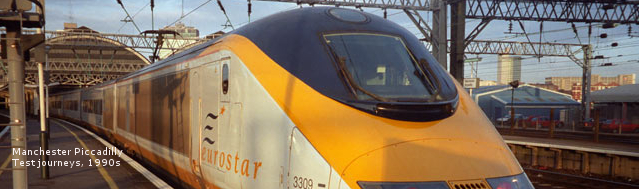
What could go wrong? Well, a worry I have is based on the Regional Eurostar debacle. It was 25 years ago when we wasted an opportunity to have trains running from all parts of England, Scotland, and Wales through the Channel Tunnel to Paris. A timeline is given here (final page of pdf).

This new service almost started – the new trains had been delivered, the staff were qualified, the tests runs were underway – but the project spectacularly fell apart, with Parliamentary enquiries for years to come. And to this day everyone involved seems to have a different reason to give for the Regional Eurostar project failure. My suspicion is that all the railway companies that bid for the franchise cherry-picked the London route alone, and with railway privatisation coming in a few years the government gave way. I have written previously on the practicalities of re-instating the Regional Eurostar project aims ahead of the completion of HS2, here.

We need to learn from the past attempts and look forward to making it happen this time.
And in the world of railways the devil is in the detail. A project can have twelve elements, and if only one element fails then the whole project fails.

At the moment the critical factor seems to be immigration systems. Immigration controls for HS1 are done by British officials working in on the railway station platforms in Paris (and in Brussels and Lille). That way, there are minimal difficulties once in the UK, and the British tabloids don’t need to worry about migrants pressing the emergency stop button and running away through the fields of Kent. 

But following Brexit and the Calais migrant camp issues, the French government has said this working arrangement is now in doubt, and will be thrown into the big pot of Brexit negotiation issues. Worse, because it is a bilateral agreement and not an EU agreement, it could be terminated by the French government anyway, even if lawyers might complain about the abrupt process. 

Would this be a bad development? Consider some alternatives:

  1. UK immigration checks happen in Dover. Every train stops, people get out and are checked, then they get back on the train. This process already happens (in Lille) for the winter special ski trains from the south of France.
  2. UK immigration checks happen at the arrival station. This would start with St Pancras and Ashford, but would need to also happen in Manchester (for example) if Continental trains ran on to HS2. But will the British tabloids and politicians accept the risk of people running off?
  3. UK immigration checks happen on the train while it is moving. This was the suggested approach for the Regional Eurostar service, but was rejected at the time. It might actually be the least disruptive option now, especially using newer technologies.

All of these options are solutions, the question is which one is to be followed?

So to summarise, at the moment it is: 

HS2 to Paris … via HS1 … via the Home Office.

The ‘Blair’s blood’ demo in 1997 had a profound impact and changed the rules

The Blair’s Blood demonstration in London in December 1997 was small but had a massive impact – it changed UK politics on welfare reform for ten years, and taught the New Labour cohort of politicians and advisors that disabled people had political power. How did this happen, and could it be achieved again?

The Blair’s Blood demonstration almost did not happen. The main protest was to be held the following day in Trafalgar Square, being only about a kilometre or half a mile away from Downing Street but a hundred miles away in terms of media coverage. 

The protest was against the welfare reforms – cuts – being proposed by the New Labour government. The protest was organised by a disabled people’s non-violent street protests campaign group called DAN, the Direct Action Network.

Before the protest in Trafalgar Square there was some frustration amongst the DAN activists at the lack of media interest. About 20 disabled people decided to stage a further, unplanned protest the  day before at the security gates to Downing Street nearby. DAN members as a group were experienced in surprise protest tactics, and it wasn’t immediately obvious to the police officers at the scene that this small group going along the pavement of Whitehall would become a further protest.

At the time it was usual for the national print and television media to keep a presence of photographers and camera crews at Downing Street. This group would supply pictures of various ministers, including the Prime Minister Tony Blair, arriving and leaving the main offices of the government.

Reports indicate that four of the 20 DAN protesters were wheelchair users. In a highly effective and visually compelling manner, some of the wheelchair users threw themselves to the ground up against the security gates and smeared themselves and the floor around them in bright red paint. The slogan was Blair’s Blood, and it caused a wildfire of TV and newspaper coverage with the bright colour pictures resembling a crime scene. There was some internet coverage, but in 1997 the internet was not yet the main media channel for news.

Alan Holdsworth recalls: “I think it was we called a snap action called a day before as you say about 20 turned up. We had the red paint in charity collecting tins saying, Tony Makes us Beg! It was Kevin’s first action as a Danner traveling all the way from Liverpool. We met at Westminster Abbey went to Downing Street, got out of our chairs and threw the red paint out of our cans. I remember how cold it was and was really worried about Kevin in his tee shirt. Nigel had a seizure but the cops just thought he was playing around. Still no arrests and I remember thinking if we don’t get into jail soon we’ll freeze to death. I started crawling towards the police wiping the red paint closer and closer to them that did it and soon we were in the nice warm police station off Trafalgar Square. It made the front page of the New York Times.”

This wildfire of press coverage mattered in two very significant ways. 

Firstly, up to this protest the New Labour core group of politicians and their advisers had prided themselves in their control of news stories. 

This was the age of the new skills of spinning the news and of instant rebuttal, where the journalists at the time were finding it very hard to challenge and question the power of the New Labour message. It was a tremendous shock to the egos of the New Labour media handlers that a small group of unknown disabled people could so massively defeat them. The New Labour era of believing in their own media superpowers, enjoyed before and after the landslide general election result six months earlier, had suddenly ended. 

Secondly, the Blair’s Blood demonstration brought home to New Labour politicians that so-called traditional Labour voters, the core group, could not be taken for granted when making political decisions. 

The fashion at the time was for something called triangulation, where politicians took the traditional left and right wing responses and then created a third response, midway but forward, which would defeat all challengers. An early classic example of triangulation was the slogan used by Tony Blair in the early 1990s in opposition as Shadow Home Secretary: tough on crime, tough on the causes of crime. The Blair’s Blood demonstration was a stark message to New Labour that the core group could not be taken for granted. 

The sharp lesson was that the welfare benefits of disabled people could not be easily cut by adding a bit of media spin and changing the headline from cuts to reforms.

This article was amended on 30 October 2016 to clarify the date of the Trafalgar Square protest, and to add the quote from Alan Houldsworth.

This is from the BBC at the time:

Protesters throw ‘Blair’s blood’

Disabled protesters have thrown red paint over Downing Street’s gates during a protest against the Government’s welfare reforms.

The group chanted slogans against the Prime Minister, Tony Blair, outside his official residence, Number 10 Downing Street.

The paint was thrown at the gate blocking public access to the street from Whitehall.

“Blair’s Blood” was daubed on the pavement nearby.

Four protesters got out of their wheelchairs to smear the red paint on the road.

Kevin Donnellon, 35, … said the Government’s intention to reform the benefits system would lead him to lose his invalidity benefit and mobility allowance.

“These benefits are worth around £150 a week to me and my whole lifestyle is based around getting this money.

“I live on my own and I also have to pay for home help care so that will be under threat now.

“I feel that the Government are picking on us as soft targets, but we are going to show them that we are not soft targets.”

He said: “I will not be able to run my car without my benefit and allowance money.

Another of the protesters handcuffed himself to the gates across Downing Street as more police officers began to arrive on the scene.

The protesters chanted “Tony, Tony, shame on you” as they made their way from Westminster Abbey to Downing Street.

Police arrived at the protest, which was organised by the Disabled People’s Direct Action Network.

Around 20 people attended the protest.


Published: Tuesday, December 23, 1997 at 08:16 GMT

Link: http://news.bbc.co.uk/2/hi/uk_news/41746.stm
Human Rights and Anger

Currently, it is claimed, there is not much support being found amongst Britain people to defend the idea of human rights. Various reasons are suggested, along with some hoped-for improvements.

Neil Crowther has usefully covered the current position in this debate here – https://makingrightsmakesense.wordpress.com/2016/10/19/reflections-on-who-are-we-hate-hostility-and-human-rights-in-a-post-brexit-world-by-martha-spurrier/

I want to argue here that we need to do something more than is often currently being suggested, and to start this we need to have a deeper analysis of the problems we face when we are trying to defend human rights.

To do this, lets go back to 1983. The British government at the time was deeply unpopular and was heading towards losing the next election. Unemployment was over three million people and inflation was rising. The government was following an economic policy called monetarism, spending less on manufacturing and favouring financial markets instead. Then, starting by accident rather than design, the Falklands / Malvinas “war” happened and the government’s popularity soared, staying in power for a further 14 years.

And what was the lesson learnt? That people’s lives may be deep in the shit, but as long as they have an ‘other’ to hate then all can be managed and contained. The phrase bread and circuses used to be popular, taken from Roman times on how to manage a population. It was perhaps too benign a translation, it was really bread and executions.

Now, to stay fresh the ‘other’ has to change from time to time. Argentinians had their uses, but we’ve also seen anger at prisoners, hated for having satellite colour TV and prawn salad sandwiches served in their rooms on sliver trays with a coleslaw garnish. Almost. So you get the drift how post-truth journalism works. Today it is the turn of people whose faith is Islam – Muslims. And so, we learn this week from the Independent Press Standards Organisation, it is permissible to attack a fellow journalist for wearing a headscarf.

And what is it that stops us giving the hated ‘other’ the kicking they deserve – human rights. It tries to stop someone being sent abroad to be tortured. To stop someone being locked up without a fair trial. To stop the abuse of the ‘other’, even though the angry crowd is watching and waiting, wanting to enjoy the schadenfreude of seeing the ‘other’ in pain.

Because when people are angry, as in the 1930s Great Depression, it suits power to channel that anger against the ‘other’. Which is why the Universal Declaration of Human Rights at the United Nations, as well as the European convention and court all rose in the 1940s after the Holocaust.

And the ethics of human rights goes back much further, such as the Abrahamic tradition of: love your neighbour as yourself; and hate the sin, love the sinner. Today it would be: tackle the ball not the player. And our appeal to human rights is to respect the referee, to play a clean game. So, the answer to anger at the ‘other’ is to explain the anger as well as defending the ‘other’ against the hatred aimed at them.

Defence alone just feeds the anger by giving it a bigger target.

So, I’d suggest that we need to call for human rights for everyone, for every ‘other’ everywhere, including places such as North Korea. This is not frivolous – we have seen how disabled children are incarcerated and abused in many countries. No country has perfect authorities, so we all need the power to limit authority in order to protect ourselves from abuse. Human rights give us that power. The call for freedom around the world in the last century was for people to rise up and shake off their chains. Well, in terms of human rights, the world’s disabled people are still in chains.

Firstly, we must set a standard. If rights are universal then we need to show that everywhere counts, and by implication we show that “British human rights” is a nonsense, like British oxygen or British clouds. We need to say that the idea of the United Nations Universal Declaration of Human Rights is still worth fighting for.

Secondly, we must set a challenge. Would you deny to people in the UK the same rights which we would want to see in all other countries? To do this we have to remind people that Britain is not exceptional. We must continue to tell the stories of abuses in the UK, not least to counter the superior view that other countries need human rights laws, but we don’t because we are somehow better. From Hillsborough to historic child abuse, there are many stories where the establishment has closed ranks to protect its own. It is the elite that benefits when ordinary people lose their human rights.

Thirdly, we must explain the wider anger. Your longer wait to see an NHS doctor is because of cuts, not migrants. Migrants pay more taxes than non-migrants. Your elderly parent’s loss of social care is the same. Your inability to afford a decent holiday for your family is because wages have fallen since 2008 everywhere, not just where migrants live. Your child being in a school class of 35 is because of cuts, not migrants.

Your life is worse now because of inequality – cuts in pay and services if you are poor and tax scams and growing profits if you are rich.

You are right to be angry. But human rights are not the problem.

More Brexit thoughts – EU Plus and EU Minus

We already have the reality of a “two speed Europe” with the existence of sub-groups such as the Eurozone for currency and Schengen for travel, plus the European Customs Union which also includes non-EU countries such as Turkey except for agriculture exports.

So we can imagine consolidating this idea with a core group of around 20 or so EU countries called “EU Plus” and the other 10 or so called “EU Minus“. The Plus group are all those who sign up for everything on offer; the Minus group are the sceptics like Denmark or the fractured like Belgium.

Membership would be mobile, like football leagues. For example, Belgium would probably now go down into the Minus group because of Walloon’s fallout. Minus countries can apply for Plus membership based on their track record of good behaviour.

So, would UK Brexit criteria “fit” with the Minus group?

Well, maybe. Consider also if regions (eg Scotland, Northern Ireland) could apply directly for “Minus” membership even if the member state (eg UK) is not a member, provided the member state was in the Customs Union.

This would mean that single market rules would apply regionally, including free movement of people, but not in England and Wales. There could well be no internal hard borders because of the customs union. Residency rights would need to be regional rather than national, administered by local authorities as they do with the electoral roll. It also separates residency rights from nationality. The increasing millions of people with multiple nationalities also makes it less important than residency rights as time goes by.

London might want to become a region too, and it certainly has the population size to qualify. The UK Home Office would probably have a fit of the heebie jeebies, but it would do them good to lighten up a bit. We could also imagine other regions wanting to opt into the EU via the Minus group route, for example the South West of England for rural benefits. Gibraltar too.

As we have seen recently, the EU already struggles to get unanimous decisions from 28 different member states. So perhaps the future is to make two speeds official policy, and allow it down to the regional level.

For different reasons, the countries most against this arrangement would probably be France and Spain, each fearing a loss of central government control over their discontented regions such as Brittany and Catalonia. Until recently the UK would have been in this group too, but Brexit means the UK’s influence here is gone.

So, Brexit could well mean regional rights are back on the EU agenda.