Category Archives: Uncategorized

New Economics – alternative models to crash, boom and bust.

Crash, Boom and Bust may sound like a punk band that never quite made the big time. But in economics, unfortunately, they are still on a world tour.

I’ve blogged before on the new ideas in economic theories, and the efforts of students at the University of Manchester to get official recognition for these new approaches by having these ideas taught as optional modules on their course. As The Guardian newspaper reports today (link below) one year on, these new ideas are still facing some academic resistance.

The classic example is that road accidents are economically “good things”. More work for car repair garages. More work for doctors and nurses. More work for the police. Everyone is a winner, according to traditional economists. Except the people who were in the car, cycling or crossing the road, but their awful experience literally doesn’t count, because it puts no new money in the till.

And therefore new economics also looks at and counts factors such as environmental degradation, inequalities, development, fair trade, fuel poverty, food banks, and the value of nurturing and caring.

So well done to these students for persevering with trying to broaden a course, hopefully one day preparing the next generation of economists to be able to do more than just get jobs running last year’s Excel spreadsheets for a merchant bank.

Link: http://www.theguardian.com/commentisfree/2014/apr/07/uk-universities-alternative-economics-models-post-crash-society

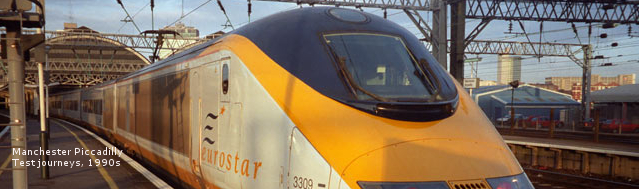
Prospects for Direct Trains from Manchester to Paris with the postponed link between HS1 and HS2 in the Higgins Review

This week has seen some important statements about the proposed linkage between HS1 and HS2 linkage being scrapped, or at least postponed. I have been writing about a possible direct service between Manchester and Paris since 2007, and I consider the planned link to be important. However, we need to remind ourselves that we already have a link between HS1 and the West Coast Main Line.

I can understand why the Higgins review took the decision on removing the link from the first phase of the construction of HS2, and I would suggest the main factors are:

1. To maintain cross-party support for HS2 by removing a £700m element. This removal shows that fears about cost overruns are being taken seriously. The “no blank cheques” statement by the Labour Party was in fact a relief after a few worrying weeks where it looked like support for HS2 might be given up entirely as a public statement of strong future control of finances.

2. To extend the first phase of construction to Crewe. This is a massive reassurance to the north of England that the first phase of HS2 will not just be used to connect the Midlands to London and then stop. The worry is that any government will keep putting off starting the second leg to the north of Birmingham. The great logic of Crewe is that it isn’t too big a step nor too large a project to finish the lines to the north.

3. To reassure communities living around Euston that large-scale housing demolitions were not going to happen. While the impact of HS2 in rural areas receives a lot of coverage, the bulk of the housing upheaval actually could happen within London. The new track layout in and around Euston station is still unsettled, so discussions of a link to nearby St Pancras are premature. Crucially, it depends on two decisions: how much expensive tunnelling is done, and to what extent Euston becomes an East-West through-station rather than remaining only a North-South terminus.

So, while the removal of the link from the first phase of construction is symbolically disappointing, it is also understandable. It is not a show-stopper in terms of direct trains from Manchester through the Channel Tunnel to the continent of Europe. The published business case describes how such services could run now.

And extra time should allow for a better designed link. As Boris Johnson, Mayor of London, told Construction News (26 March 2014), “trying to get these high-speed trains to dicker over the existing tracks in north London and then join up with HS1 wasn’t the right way forward. HS1 and HS2 need to be joined in a tunnel and that will eventually happen. David [Higgins] was right to say that in the first phase, don’t do the HS1/2 link as it’s currently on the table, because there’s no point. It’s bad news for transport in London and it’s not the right scheme.”

HS2 won’t link to HS1 – north of England cut off from Channel Tunnel again – repeat of Regional Eurostar fiasco

The BBC is reporting that HS2 will not connect to HS1, depriving the north of England from direct trains through the Channel Tunnel.

20 years ago another Government did the very same thing, withdrawing the planned Regional Eurostar service. It sold the trains to France and Canada, and closed down the depots.

For the full timeline, see the last page of the document linked below. This report also shows that it is possible even today to link Manchester to Paris – all the technical details are there for any sceptics.

http://www.bbc.co.uk/news/business-26717518

Download: Innovation in Manchester to Paris Overnight Rail with Existing Resources (PDF)

night trains manchester to paris 2012

A budget for construction, and disenchantment with current volume house builders

Today’s budget statement focused on construction, with an ambition to see a further 200,000 new homes being built.

But behind this number it seems there is a disenchantment with the volume house building firms. We see new money for Right to Build, to encourage public bodies to sell land at a market rate to self-builders. We also see a new fund to encourage more activity by SME builder-developers.

After all, Ebbsfleet in Kent is essentially the public sector giving a stutteringly slow rate of private sector house building a kick in the pants, to be blunt.

It has been noted that, on the European Continent, it is commonplace for people to directly pay a builder to create their bespoke house. Less understood is that a lot of these new homes are essentially chosen out of a catalogue, then delivered to site in modules direct from factories, and assembled to very high standards in just a few days by trained teams from the same factory. There was a rare example of this shown in the UK some years ago on the Grand Designs TV programme, where the new home and team came on lorries from Germany.

Frankly, until we get comfortable with offsite manufacturing of modules and panels, and with integrated manufacturing and assembling, then self-builders, or rather self-developers, in the UK will remain a minority hobby. The first firm to achieve this at scale will boost UK manufacturing as well as construction, and the first conurbation to assemble this new economic cluster will steal a march on others areas.

Any takers?

Back from our travels

We’re now back from 8 weeks in Tenerife, avoiding the worst of the severe strains of the UK winter. We added to our enjoyment with Spanish classes on the terrace, taught by a young Russian woman in a small class including Germans, Austrians, Dutch and Finns. As usual, we stayed at Mar y Sol in Los Cristianos and met up with many friends from previous visits, both staff and guests.

One of the highlights was having a haiku (poem) retweeted by Jack Munroe – *fame*. It received a large number of views via LinkedIn as well. What is new is how most people come to the blog via Twitter. The second most common route to the blog is via search engines, and dear old LinkedIn is dropping to third.

The next book is 14k words in, and I am now being followed by the EU Commissioner for the Regions and by BIS in the UK. As ever, in the blogs I am following a professional line of being honest and ethical while not breaking confidences. Recent topics included reducing carbon emissions and on housing economics.

However, the most read blog so far this year is on press reports of rumours that the planned connection between HS2 and HS1 will be axed. This relates to one of my dear lost causes – promoting the idea of an overnight train between Manchester and Paris. One day… 🙂

Happy March everyone.

Will economists and social scientists ever speak the same language about housing?

I ask myself this question when I write about housing as a ‘commodity’. It does seem at times that economists and social scientists, allegedly sharing the same academic faculty of the Humanities, are destined to speak at cross purposes. Which, for clever people, seems a bit odd.

A social scientists reads ‘commodity’ as a bad thing – it is a public good which has become privatised, such as having to pay a toll or fee to go across what was previously common land.

But an economist talks about commodities as products which used to be an expensive and famous brand but are now being made very cheaply, which for most people is a good thing. Current examples would be DVD and MP3 players. It also covers goods such as milk, potatoes, eggs, where there is virtually no brand power.

An alternative phrase to commodity would be talk about housing as a ‘utility’, but we run into the same terminology problems as above because of the current culture of privatisation, at least in the UK.

OK, slightly interesting, but does this really matter?

Yes – just consider the difference between the cost of housing and the price of housing. The average UK purchase price for a family house is now around £250,000. But the cost of building that family house is much less. Most building firms keep this figure a commercial secret, but with economies of scale and using more modular offsite manufacturing of the complicated rooms such as bathrooms and kitchens, a house build cost of under £60,000 is perfectly feasible. The big difference between price and cost is made up from sales, tax, land and profit.

Up to 2008 when house prices were rising rapidly, central and local government benefitted from extra tax income, and the private sector benefitted from growing land receipts and from profits through sales, but mostly based on private credit. Of course, the housing market is different now, especially outside of London and the south east of England. And linking affordable housing to employment is now a significant challenge across the UK, where it is often a stark choice of one or the other but not both.

But, if by housing as a utility or a commodity we mean that it should be cheap and affordable, then now is the time to look at new models of delivery. This could probably start in the social housing sector because prices and costs can be more readily controlled. It would involve a long-term switch of funding from revenue to capital, from Housing Benefit towards house building. It would also impact on the housing market generally, reducing upward pressures on private rents and purchase prices. It would look at economies of scale, possibly by consolidating social housing building micro programmes at a city or regional level, using a client-managed consortium of suppliers to balance the risk of non-delivery.

Alongside house building, the significant amounts of empty property could be incentivised back into use by a market shift whereby empty property would have reduced income as an unused asset but significant income growth via rent. Higher taxes on empty property would help push this trend, as would lower taxes on rent.

So finally, perhaps economists and social scientists could agree that: yes, housing is already being used as a commodity, and the next phase is to make it an affordable commodity.

Disclaimer: private views, as ever. Tony previously worked at the Centre for Construction Innovation based in Manchester.

Britain now has fewer than 1,000 independent bookshops

Worryingly, the number of independent bookshops in the UK has dipped below one thousand. Those that manage to continue thriving are said to have diversified, working with schools and community hubs. The article below makes the economic case for sustaining High Street shopping, but I also think a good bookshop is a cultural and health necessity for any decent size town. Reading is good for people’s wellbeing. And in some places, the best range of books locally now is at the Oxfam shop.

www.independent.co.uk/arts-entertainment/books/news/britain-now-has-fewer-than-1000-independent-bookshops-for-the-first-time-since-records-began-9145189.html

Manchester plans to keep on reducing its carbon emissions – some thoughts

The February update from Manchester A Certain Future (MACF) http://ontheplatform.org.uk has arrived this week with news on efforts by all partners towards reducing the carbon footprint of Manchester, which I fully support.

MACF is a broad based organisation of many partners and philosophies, from some neoliberal globalisation in economic policy to grass roots local cooperatives and campaigns. Any progressive city is necessarily a mixture of movements, beliefs, organisations, authorities and trends. So, for example, it would be unrealistic to look for a uniform ‘party line’ and it is better that different interests find a way to ‘rub along’ for the greater good.

There are some encouraging signs. For example, Manchester City Council plans to replace 56,000 street lights with low-energy LED lamps, saving up to 60% on carbon emissions. Probably many Manchester partners first saw an LED street lamp at CCI and CUBE on Portland Street. It was the early production prototype Philips 82watt lamp, part of an exhibition on new indoor and outdoor low-energy lights.

But some signs are less encouraging.

Many of us had assumed that higher energy prices were a natural ratchet which would lead to less energy demand and consumption. Better insulation and high-efficiency boilers would become cheaper – and more attractive each year – when compared with rising energy bills. Well, we learnt the hard way in 2013 that this model has limits, especially when there is a context of austerity and reducing living standards. People pushed back on prices, rather than spending more now to save later.

Yet in MACF there is (still) a stated desire to maximise the “multi-million pound Green Deal” programme in 2014. Really? Even after the abysmal national take-up figures in 2013 and then the shift of ECO cost collection away from using consumer fuel bills and on to general taxation? It feels very unlikely, unless Green Deal now is only about the ECO payments to social landlords, in which case the Treasury would probably give it to HCA to manage as grant aid.

So, it feels there is a bit of catching up to do. I know that is a challenge currently, especially when many organisations have shrinking resources and are being hollowed out. But we must show the resilience we look for in others, and find ways to be optimistic as well as determined.

The recent storms and flooding in the UK have brought climate change into sharp focus, and early 2014 might be a moment when the popular mood changes. But we should be careful not to rely on it too much. It would be lovely to think that, when the prime minister said “money is no object” that all our wishes will now come true. But what he said was just to rephrase something well known in the public sector, which states that any public service is allowed to break the rules when it is a matter of saving life and limb – “money is no object in a relief effort”. Unfortunately for the climate change agenda, the increased spending on flood defences in the UK will probably come from the two usual suspects of savings and contingencies. For some time now, it has been ever thus.

The storms and flooding may lead to a new emphasis on adaptation, but possibly with even less effort on prevention. After all, it is possible to fully support adaptation without admitting that carbon emissions are the problem. Adaptation alone does not ask questions about the causes of climate change, so it could be caused by … sunspots, natural cycles, or even changes in the price of Marmite.

In my opinion, and supported by science, climate change prevention (or reduction, given it has already started) is essential. But if there is no major national shift towards prevention and therefore stronger reductions in carbon emissions, even though I and many others wish it would happen, what are Manchester and other cities to do?

Transport and the heating of buildings remain the high impact sectors for reducing carbon emissions. The MACF ambition for more people in buildings to show their visitors a Display Energy Certificate (DEC) is one that I hope takes a strong hold. I have said before that every shop window on Market Street or in the Northern Quarter should have a DEC in the corner. Keep it simple, uncluttered, A5 size is enough, showing their A to G rating and maybe a QR barcode for anyone who wants more details. Surely a great student project.

Another practicality. For carbon literacy and buildings I would suggest that in the built environment professions we start to examine the use of U values. For example, windows. A double glazed or triple glazed window makes a building warmer because it is better insulated, and the measurement of the amount of insulation is its U value. The lower it is, the better. But when new windows are advertised on TV, there is no mention of U values. TV ads instead talk about windows being “Triple A Rated” or similar. In terms of insulation, many people now will know about duvets and togs. The higher the tog number, the warmer it is, because the higher the amount of insulation. Some good engineers will wince here, because togs are for textiles and U values are for building materials. But … carbon literacy, folks … I would ask: if your choice between two new windows is U values of 0.67 and 1.1, what do you think? Now, if I tell you the two windows have values of tog 9 and tog 15, is that any clearer now which one will give you a warmer room? I think so.

So, the take-home message for the built environment and housing professions is, show a DEC and talk tog.

Disclaimer: My personal views only. So far I have worked for national, regional and local government, the private sector, the voluntary sector, and universities. That only leaves the church and the military still to do, though I did once have a boss who was an ex-army chaplain. Nothing in these blog postings is a statement of the policies or practices of any current or former clients or employers.
Are we entering a new era in politics?

The sad death recently of Stuart Hall and the thoughtful obituaries that have been published, along with recent public debates about extreme weather and climate change, perhaps help us first take stock of our past and then point to the possibility of a new era in politics being about to start. Of course, nothing is certain because politics is not mechanical, but let’s consider the last 60 years, as outlined in the obituaries of his working life, and how the time divides roughly into two political periods.

First, in 1956 we had Suez and Hungary. The Suez crisis caused a disenchantment with the UK, France and Israel acting as imperial powers, basically invading Egypt on a pretext. The Hungarian uprising and the Soviet crackdown showed the Eastern Bloc countries in a similar light. The resulting New Left was non-aligned, not fixed to nation states, but instead fixed to ideas of human rights and freedoms. It was the New Left that created a climate for cultural change and the ‘sixties revolution’ of supporting campaigns rather than political parties. This was CND, women’s liberation, the civil rights movement in America, Cathy Come Home and Shelter, and a nascent environmental movement.

Then, in the late 1970s we find a counter-movement politically. The oil crisis around 1973 created an economic shock in the West which took years to work through. Politics slowly moved to the right, a new era of neo-liberalism followed, summarised as Thatcherism in the UK and Reaganism in the USA, but best known now as globalisation. The solution here was to be business-led, to dismantle the structures which were said to hold back progress, including trade unions and local authorities. In the UK the New Labour movement continued in that direction in some aspects, for example requiring students to pay tuition fees, but took a more inclusive approach in other aspects, such as the network of Sure Start centres, rebuilding schools and hospitals, and in-work tax credits to address child poverty. There was a view in Russia that the two world wars in the twentieth century were essentially a conflict between democracy and capitalism, and the post-war settlement in the West was about how those two forces might rub along. Globalisation put capitalism first again, not least because democratic countries became powerless to stop flows of money leaving. The New Labour movement argued that this was a price worth paying for a new, more peaceful world order. To roughly quote a line from the TV drama, The West Wing, “Global trade stops wars. The rest we sort out afterwards.” Iraq and Afghanistan ended that hope.

However, even if wars continued, globalisation in the West contained two seeds of decline: debt and climate change. The lack of global political structures that were as strong as the forces of business meant that any international responses to debt or to climate change were essentially voluntary, by treaty, and could be ignored or avoided without penalty. Thus we see the World Bank and the International Monetary Fund making requirements on elected governments for limited amounts of borrowing while the business sector was very lightly regulated, being able to shop around the world for the best deal. The new round of Basle banking rules have been an attempt to better regulate banks internationally after the 2008 crash, but other aspects of globalisation continued as before, alongside growing levels of income inequality.

So, following the 2008 crash (from which the UK has yet to recover economically in terms of GDP, productivity or employment), and the 2014 extreme weather events (which maybe will bring climate change into political focus in the UK), this could be a moment politically when the furniture is moved for another 30-year or generational period. Crucially, any such change will hinge on how younger people respond politically to their generally declining conditions of employment, housing and debt. The national lack of trust in UK institutions as well as in the press and in political parties has, I believe, inhibited a coherent political response so far.

And when this political response does show itself, there are no guarantees it will be a good outcome. Politics is not a playground game where ‘left’ and ‘right’ take it in turns to be in charge. The move could be further to the right. The 2008 crash has produced some strong right-wing trends in some European countries, especially in blaming immigrants, most recently in Switzerland.

The pessimistic scenario is of a right-wing retrenchment across Europe, with increasing xenophobia, more intolerance of minorities, and an increasing meanness in sharing the fewer public resources available. The driver for these trends would be the continued economic decline of the West as the South (China, India, Brazil, and maybe Africa) rises. Such tensions are also evident within the South, for example the street protests and disorder in Brazil over rising costs in public transport, and the increase in street violence linked to racism.

An alternative scenario is of a new understanding of how the world’s resources are finite, and what a fair and equitable sharing of these resources would look like. Ideally, centred around maximising people’s happiness and wellbeing rather than maximising a figure of wealth. Money is only a means to an end, not the end itself.

Clearly this is an ideal, and globally there will always be countries which drag their feet, looking to squeeze an advantage over the rest. But, for me, I’d much rather face that as a problem to be dealt with, rather than have to deal with retrenchment and xenophobia with all its echoes of 1930s Europe and the conditions which supported the growth of fascism.

Disclaimer: As are all my posts here, this is a personal view.

www.tonybaldwinson.wordpress.com