Category Archives: Uncategorized

Parks in Manchester, a suggestion for Castlefield

This piece was written as a response to the consultation for the Castlefield Regeneration Framework in Manchester:

***

This response is to suggest three specific areas in which it would be useful to be more specific within the framework document: on the residential offer, on quality open space, and on connectivity.

The draft framework is explicit on the benefits of a height and massing hierarchy for new buildings in proximity to the rail viaducts, but other aspects of the framework are perhaps quite generic and could be further detailed to even better capture the opportunities of the area’s key characteristics.

In general, the Castlefield area offers an experience of changes in height, levels and scale which is not to be found to the same impressive extent elsewhere in the city centre. This unique physicality should be brought to the fore, celebrating its particular expression within the wider urban form. The rail viaducts in particular are monumental in scale, and it is not surprising that the middle area is widely used for filming due to its cinematic scale. However, the wider area has experienced less renown with a predominance of lower value uses which would normally be expected to be found beyond the inner ring road and not within a city core.

Green Infrastructure

The two rivers and the canals provide a variety of water courses and frontages which are difficult to find elsewhere in the conurbation core, combined in a manner which complements rather than copies Salford Quays, to which it is connected. The framework should use this feature as the defining basis for the area’s green infrastructure, including better linear riverside connectivity and quality open spaces reaching into the core. The schematic form of the draft framework is light on this aspect, with little shown beyond generalised boundary planting. The reference to 35 central parks is not a strong linkage, and within the framework discussions there would be benefit in exploring mechanisms to achieve quality open spaces which share the uplift in land values equitably between the various interests. Without a mechanism such as a trust or a joint venture, the provision of quality open space risks being borne unequally.

As well as green infrastructure being a deeper feature of the framework and feeding into quality open space and public realm, consideration should be given to the use of the metal unused rail viaduct next to the Metrolink route towards Cornbrook. Whether this should be open to the public would depend on a strategy to manage the area and any attendant risks, but even keeping it closed to public access it could nevertheless be planted in a manner similar to the High Line park in west New York, which was also a disused elevated railway track. Such planting could be within large containers to protect the structural integrity of the viaduct, using sculptural shrubbery with high-colour flowering shrubs to make an impact at a distance.

Connectivity

The linkages between the site and the Castlefield-Deansgate Metrolink station are mentioned but could be amplified, and could include an iconic feature which would define the experience of the area. The walking route from Metrolink, other than at road level across Deansgate, is through a high-level car park which spans Deansgate and enters Castlefield, walking to arrive at a metal stairwell or a lift, dropping considerably to ground level.

To the side of this metal stairwell, the suggestion is to build a skywalk which would take pedestrians at height into the area, either under or over the rail viaducts, to a destination on Liverpool Road next to the Museum of Science and Industry – MOSI. The design of the skywalk would be slim, tall and sleek, undulating as it approached MOSI. It would probably pass under the Manchester-Preston rail viaduct, mindful of the clearances needed for future rail overhead wire electrification if the walkway passed above. In concept it borrows for pedestrians from the Millau roadbridge in southern France, and would especially define the area in the minds of children visiting MOSI by tram.

Demographic Opportunities

The following discussion note was prepared in October 2009 and this framework provides a key opportunity to develop the residential offer of city centre living in a manner which is attractive to a wider and economically sustainable demographic.

Urban niche market opportunities for the active retired

In the field of urban regeneration there are discussions about sustainable future uses for some city-centre apartment schemes. In the last five years the growth in student renting as a niche market has been helpful, and this note is to suggest that a similar niche market could be developed for active older people, with some outline thoughts as follows, using the Castlefield area in Manchester as a case study.

Castlefield is often used as a film set, being an urban quarter with sensitive, historic and strategic features including Roman and industrial revolution connections. It has canal waterfronts, monumental transport viaducts, a YHA café, YMCA fitness centre and swimming pool, a major museum nearby plus the city centre core within walking distance – with close walkable access to the Concert Hall, Art Gallery, Royal Exchange and other theatres, Deansgate and King Street for premier shopping as well as main brand ‘metro’ supermarkets and the whole range of city centre attractions.

There could well be an opportunity in places such as this to be re-marketed with developments aimed at aspirational retired professionals looking to downsize, to let go of the car and drive less often (cars can be hired by the hour now), and to relocate their home in order to easily maintain their access to the prime leisure and cultural offers of the city centre while living in a quieter urban quarter with a waterfront or similar advantages. The fact that some developments are currently only built to shell allows for a re-thinking of some of the internal features. People with retirement income are less affected by the recession, with their purchasing power not dependent on current employment.

The internal fit-out could be informed by the Lifetime Homes standard. This might involve time costs in changed designs and drawings, but the property’s improved marketability will be worth the effort, as well as keeping a work flow for in-house design teams. More amenity space would also be attractive to older purchasers. There is sometimes adjacent underused land such as former car showroom sites which might make well-designed public and/or private open space.

The benefits of active frontages at the ground level are well documented, and a mix of small retail plus health care could be attractive and viable. In particular many city centres still need to build up the social infrastructure of GP or nurse-led health services. What could be key for prospective purchasers, along with covenants on occupation, will be visible, proactive and reassuring property management such as those with a concierge service.

October 2009 and March 2011
“Delays in the Planning System”

I heard this awful phrase yet again yesterday. The dear old Today programme on BBC Radio 4 were interviewing someone about why so few new houses are being built.

It could equally have been an interview about the shortage of affordable housing. Or even the reason why pop songs are not quite as catchy as they used to be, when we were young. Trains are running late? Well, you see, it is all because of delays in the planning system.

When journalists get trained, are they hypnotised? I wonder, because all you have to say to them is the trigger phrase – delays in the planning system – and they go all quiet and gormless.

So, what is going on here?

Firstly, we know that more houses receive planning permission than are ever built. Like land banks, there are permission banks. Sometimes these are speculative, where the land owner is trying to increase the value of their land by obtaining permission in advance. But just because you have permission to build a copy of the Eiffel Tower in Runcorn, doesn’t mean anyone else thinks they can make money from doing it.

Secondly, the planning system is quasi judicial, with expensive barristers for when the going gets tough. But it is administrative law, mostly going up the chain to Ministers rather than up to the courts. And there is an inequality of arms: the big firms can afford to pay more for barristers than can local authorities, and big firms can hold the threat of recovering costs if the local authority is judged to have been unreasonable in its denial of permission.

So, thirdly, local authorities fight the planning lawyers with bureaucracy. Which leads us to having 27 policy documents and investigations before you can build that wonderful copy of the Eiffel Tower.

But, fourthly, perhaps the biggest factor and by far the least talked about is: location, location, location.

Basically the posh councils have a problem. Everyone living there asks just two things: keep the schools decent and don’t build any new houses near us. But all the house builders want to build in these same posh areas because good location equals good money.

The not-posh councils don’t have this problem, and are often grateful for anything that comes their way, even if the quality is woeful. We have all been on trains or in cars, going past new houses at 50 miles an hour where it is painfully obvious they are far too small to live in, our slums of the future.

So, in a nutshell, delays in the planning system is often code for trying to get permission in the posh areas, often in or near the green belt, where the local voters are saying “no more” and the council they have elected is trying to defend the area from the lawyers of all comers with just a few forms, policies, processes, and ever more meetings.

And finally, I would suggest that a better line of interviewing would challenge such bald statements about delays with the deeper question: does what we are doing currently help in sustainable development, or is it a just a sideshow about money?

Journalists, please note.

This blog – 2014 in review

The WordPress.com stats helper has prepared a 2014 annual report for this blog. Here are some key points:

* This blog was viewed by 1,700 people in 42 countries, the largest number being from the UK, closely followed by USA and Canada.

* Most new readers found the blog on Facebook, then Twitter and thirdly LinkedIn.

* The most popular articles in 2014 were on the history of the disabled people’s movement, a new section added this year as the Kevin Hyett Archive.

* The third most read article in 2014 was over a year old, on ERDF and procurement.

Thank you.

New book on the welfare state: Good Times, Bad Times by John Hills

There are four key messages connected with this new book on the welfare state, I suggest:

(1) the welfare state is more than the NHS,
(2) it started with radical writers well before 1948,
(3) middle class families receive state spending as much as poorer people, and (4) welfare and inequality are two sides of the same coin.

As said in The Guardian’s reviews of this new book – “Without state redistribution, inequality in Britain would no longer be on a European or even a North American scale: the gap in the UK’s private incomes would be right up at the top of the table, close to that in Chile.”

Full review of this book – http://www.theguardian.com/books/2014/dec/11/good-times-bad-times-john-hills-review-welfare-state-tom-clark

Buy now for Christmas!

The Trust Women conference – Creating Women-friendly Cities

In Delhi, 95% of women asked feel unsafe on public transport. In the USA, 80% of women surveyed have been harassed by a male stranger. Girls are known to use public parks far less than boys after the age of 9 years. There are many other examples of such Everyday Sexism in towns and cities, so it was good to read about the TRUST WOMEN international conference which took place this month, with lots of ideas and solutions in different settings around the world.

The growth of urbanisation and mega-cities means that more women than ever are living in cities, and especially in mega-cities. The challenge now is for us, men and women, to make these cities work for everyone, and not just for men. The conference covered many experiences and solutions already in place, and these are via the link below.

For me, if I was to highlight one point it would be – the importance of employing women in roles of authority to visibly manage public spaces, from tram inspectors to parks officers to visitor guides, and more. I feel we have gone a bit too far down the CCTV and gadgets route, and lost something of the human, the role model for girls walking to school, the ability to intervene, challenge and remove that urban sexism everyday.

Link: http://blog.thomsonreuters.com/index.php/women-friendly-cities-its-not-about-money-its-about-ideas/

Ursula K. Le Guin’s speech on writing, resistance and change

I don’t normally paste other people’s stuff wholesale in a blog, but this speech below is exceptionally good:

Ursula K. Le Guin was honored at the National Book Awards tonight [19 Nov 2014] and gave a fantastic speech about the dangers to literature and how they can be stopped. As far as I know it’s not available online yet, so I’ve transcribed it from the livestream below. The parts in parentheses were ad-libbed directly to the audience, and the Neil thanked is Neil Gaiman, who presented her with the award.

She said:

“Thank you Neil, and to the givers of this beautiful reward, my thanks from the heart. My family, my agent, editors, know that my being here is their doing as well as mine, and that the beautiful reward is theirs as much as mine. And I rejoice at accepting it for, and sharing it with, all the writers who were excluded from literature for so long, my fellow authors of fantasy and science fiction—writers of the imagination, who for the last 50 years watched the beautiful rewards go to the so-called realists.

I think hard times are coming when we will be wanting the voices of writers who can see alternatives to how we live now and can see through our fear-stricken society and its obsessive technologies to other ways of being, and even imagine some real grounds for hope. We will need writers who can remember freedom. Poets, visionaries—the realists of a larger reality.

Right now, I think we need writers who know the difference between the production of a market commodity and the practice of an art. Developing written material to suit sales strategies in order to maximize corporate profit and advertising revenue is not quite the same thing as responsible book publishing or authorship. (Thank you, brave applauders.)

Yet I see sales departments given control over editorial; I see my own publishers in a silly panic of ignorance and greed, charging public libraries for an ebook six or seven times more than they charge customers. We just saw a profiteer try to punish a publisher for disobedience and writers threatened by corporate fatwa, and I see a lot of us, the producers who write the books, and make the books, accepting this. Letting commodity profiteers sell us like deodorant, and tell us what to publish and what to write. (Well, I love you too, darling.)

Books, you know, they’re not just commodities. The profit motive often is in conflict with the aims of art. We live in capitalism. Its power seems inescapable. So did the divine right of kings. Any human power can be resisted and changed by human beings. Resistance and change often begin in art, and very often in our art—the art of words.

I have had a long career and a good one. In good company. Now here, at the end of it, I really don’t want to watch American literature get sold down the river. We who live by writing and publishing want—and should demand—our fair share of the proceeds. But the name of our beautiful reward is not profit. Its name is freedom.

Thank you.”

Source: http://parkerhiggins.net/2014/11/will-need-writers-can-remember-freedom-ursula-k-le-guin-national-book-awards/

Night Trains being cut across the EU

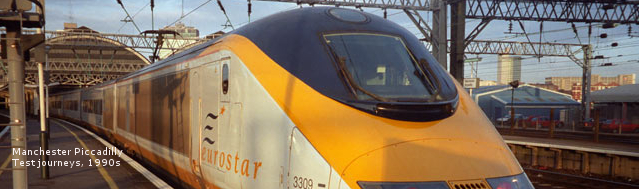
This month the German train operator DB announced it is cutting many night train services including from Copenhagen to Prague, and from Paris to Berlin. I have been campaigning for a night train between Manchester and Paris.

Katie Mitchell wrote about these changes in The Guardian on 18 September 2014, and the “huge blow” this is to people like her who regularly use night trains. She has given up air travel in favour of trains, but still needs to get to her work in different European cities without extra days of travelling.

Her article attracted 328 comments, which I read to distill the essence of these changes to night trains. Of course, it is necessary to filter out a sadly large number of comments which are plain abusive and those just pumping oil. From the sensible comments the key factors at the moment seem to be:

1. The German government has recently allowed long-distance overnight buses to start operating, and there is a cut-price market here while rival companies try to build up their market share and drive out competitors.

2. The EU transport rules forbid any government from subsidising international train services, though governments can subsidise services that only run within their borders.

3. Governments can subsidise air travel by absorbing certain general costs such as security, air traffic control, fuel duty exemptions, and airport infrastructures.

4. The growth in night freight trains has begun to crowd out night passenger trains, including new rules where some long tunnels cannot be used by a mix of freight and passenger trains at the same time.

5. The growth of high-speed rail services between EU cities has made some previously overnight services viable during the day; however this change has not been synchronised with extending the ‘reach’ of overnight services to other cities further apart.

Number two, the EU prohibition of subsiding international train services, seems particularly harsh given the subsidies (investments) that are permitted for road and air travel. It rather feels like living in the USA early last century when the car companies tried to kill support for public transport or mass transit.

We need a more thoughtful, modern and effective EU rule for international rail.

More papers for the Disability Studies Archive at Leeds University

Recently three archive boxes of papers from the files of Kevin Hyett (1958-2004) were added to the Disability Studies Archive at the University of Leeds, known as the Leeds Archive. The placing of these papers within the archive will ensure their safekeeping and their availability to future generations of researchers and activists.

Perhaps the strongest set of papers within his files are those concerning UPIAS – the Union of Physically Impaired Against Segregation.

Some of these papers can be accessed online at — https://tonybaldwinson.wordpress.com/kevin-hyett-archive/ But not all the UPIAS papers are available online. The criteria used to decide which papers are on the web is –

What was public at the time is public now, and what was private at the time remains private now.

– “Public” papers include, for example: newsletters, minutes, agendas, reports, press cuttings, website contents.

– “Private” papers are, for example: membership forms with names and addresses, personal correspondence, membership lists, mailing lists, confidential minutes, databases.

For the UK National Archives, the rule is that private and personal data remains closed from publication for 100 years after its creation. For example, the 1921 Census papers will become publicly available in 2021.

Of particular concern here, there was the UPIAS Circular which was a private, confidential circular for the members only, and not allowed to have a wider circulation or readership. As a member, Kevin had a few editions of the circular and these are now in the Leeds Archive.

There were around 62 editions of the circular, and it would be excellent if copies of every one could be located from various attics and cupboards.

The advantage of somewhere like the Leeds Archive is that these private papers can be held in a closed or controlled archive. This means they are only available to genuine researchers, and can only be used in careful, ethical ways. For example, a researcher can read a copy to understand an issue better, but they cannot print the circular for others nor publish it online.