Category Archives: Uncategorized

The politics of staying in the EU is mixed up with the politics of the euro

A number of left-wing commentators have written recently on the forthcoming UK referendum on continuing membership of the EU. The gist of these topical pieces is that the British left-wing should campaign for the exit of the UK, and not leave the running to UKIP. They acknowledge that the EU was pro-labour in the 1980s but since then it has become very pro-capital. The developments in Greece are seen as the starkest moment yet when these pro-capital powers are put to use, against the people.
OK, declaration due, my work often involves EU funding for public and third sector projects in the UK. But that apart, the UK always provided at least 50% of the funding and in some years the UK funds were far more generous and wide-reaching than the EU funds, though not any more because of austerity policies.
The EU is a massive compromise: between East and West Europe; North and South Europe; labour and business interests; left-wing and right-wing national governments. Some national leaders can work with compromise, but usually the more extreme leaders take an absolute position – my way or no way.
For the left, I think the fundamental issue is whether the EU is seen as an instrument of internationalism or one of globalisation?
For me, the flame is still lit – but flickering – for internationalism. The appalling treatment of Greece by the EU as well as the International Monetary Fund and the European Central Bank must be a lesson we learn from. The euro does not belong to any one country, despite Germany being the home of the ECB as a sop to local sentiment. Of course, there were horrors of hyperinflation in the 1920s and 1930s, but there were also massive subsidies such as the Marshall Plan from the USA in the 1950s.
But more than all these financial and economic arguments is the human one – the EU is foremost a peace-keeping project or it is pointless. Every straight banana and curly cucumber is absolutely worth it to save us from fighting ourselves.
And across Europe we pick our fights more easily than we like to think, whether it is in the Middle East or closer to home.
I guess where this leaves me is that the left-wing commentators have not yet found a compelling strategy to tackle globalisation, apart from retreating from anything international in case ‘business’ takes it over. And in the UK the New Labour project fundamentally said it could work with business for social justice, even though inequalities rose throughout its time in power.
To start to tackle globalisation, we need to look at reintroducing capital controls and exchange rates to protect weaker economies, and here the target needs to be the euro rule book not the EU.

Zero-carbon homes and Productivity

Some days it is hard to be an optimist. The axing of official zero-carbon homes ambitions is one of those days.

I am reminded of the following self-deprecating quote, written in 1968 by the respected Fabian politician Leonard Woolf:

“I see clearly that I have achieved practically nothing. The world today and the history of the human anthill during the last fifty-seven years would be exactly the same as it is if I had played ping pong instead of sitting on committees and writing books”.

And blogs, we might add today.

But still we must push on, onward and upward!

http://www.theguardian.com/politics/2015/jul/10/productivity-plan-death-knell-zero-carbon-homes

Learning Societies, Cities and Austerity

In their book, Creating a Learning Society, written by Professors Stiglitz and Greenwald and published last year, they look in detail on the economic benefits of learning. It may seem strange, but up to now most economists have argued that productivity mostly increases because of changes in technology and in capital.

They use their phrase, a learning society, at a number of levels: a country, a city, an organisation, a company. The book is detailed, but some of their main conclusions are that –

1 – most firms operate below optimal productivity, with firms in most sectors showing big differences between the levels of average and best practices (room for improvement)

2 – organisations in some economic sectors are better at learning than those in other sectors

3 – knowledge is about far more than just the law (patents) and universities (research)

4 – tacit knowledge includes how individuals and organisations interact, and the norms of behaviour within organisations, institutions and networks

5 – free market economies alone usually fail to efficiently transmit knowledge,

and that

6 – productivity depends on learning how to do things better, through “the continuous accumulation of small improvements”, rather than, say, working people harder or longer for less pay.

They quote as a case study the position of improving productivity in South Korea. The classic economist’s advice would be for them to become ever more productive in producing rice. But although they would be highly productive, they would still be poor. Instead they chose to develop their semiconductor manufacturing, and became rich.

Enough of the book.

I would just add that tacit knowledge is not captured by asking someone to write down what they do before they leave.

Now, let’s consider a European city, one where austerity is cutting deep into the public sector. We can imagine that many cities are operating below par, but that some others are showing best practice. The best practices would be based on pulling together a number of small improvements, rather than one ‘big bang’. And mostly, these improvements are in behaviours, in norms, in how the people working in the city’s organisations work together.

Now apply austerity to that city’s public sector. Remove experienced people to save money. Ask the remaining staff to “do more with less”.

So, based on the economic theories of learning societies, I’d suggest we can now see how austerity will lead to a decline in the productivity of the city.

To understand 2007 we need to start with the 1970s

The first news of the forthcoming economic crash in 2007 was probably a small article inside the Financial Times on Valentine’s Day, 14 February 2007. The article reported that market analysts in Germany were beginning to notice troubles in the mortgages market in the USA. Within a few months everyone would know what sub-prime meant.

We think of the economic crash of 2007/8 as being a banking crisis, especially because some banks failed completely (Lehman Brothers) and some could only survive with massive injections of public funds (Royal Bank of Scotland). But it is more helpful to see the crash as a credit crisis rather than as a banking crisis – cause rather than effect.

When UK Conservative politicians talk about “overspending” and “the mess of the last Labour government”, it still strikes a chord with much of the electorate. This is despite the technical protests and detailed articles of many economists and commentators. But perhaps the reason that it still strikes a chord is that it touches on a deeper truth.

Essentially from the mid-1990s to 2006 we had a very long credit boom. Even Radio 4 presenters were moaning on-air about all the unsolicited credit cards popping through their letter boxes week after week. Sub-prime mortgages were just the most vulnerable edge of the market. The construction sector in Spain had gone frankly bonkers. Icelandic banks were held up as respectably turning base metal into gold. PhD students in mathematics were being offered silly salaries to present a veneer of plausibility, creating devices such as credit default swaps and fancy models for value at risk.

So it was a private sector credit boom that burst in 2007, and the political twist has been to paint it as a public sector crisis. But if you don’t blame “the last Labour government” then who do you blame instead? The electorate themselves for living high on the never-never? They won’t thank you for trying that one, I fear.

We need to take a longer view.

Worldwide, most people’s incomes in developed economies have stagnated since the 1970s with steadily growing inequality as a super-rich class grew from strength to strength. The decline of many cities (consider Baltimore) and regions (like steel and mining communities) has been the starkest indicator of this trend. The 1995-2007 credit boom was a reprieve, gladly accepted even though we knew it was unsustainable. It gave us some warmth, some days in the sun. And yes, it rebuilt schools that still had outside toilets. Why not?

But rather than admit our own weakness for a temporary reprieve, collectively it is easier to blame a politician for that extra holiday we took, the new car, the early retirement. So we end up being told what we’d like to hear – that if only the local hospital had not had some new wards built, we wouldn’t be in this mess. Really?

But we don’t need to blame ourselves, because we would not have needed that credit if most people’s incomes had not stagnated for nearly two generations. And the fix for this is a combination of progressive taxation and border controls for money.

The downside of globalisation has been the unregulated flow of money across borders. Profits can be legally transferred to tax havens by respectable accountants. Even within the EU we see countries such as Luxembourg shamefully acting as tax shelters for the rich in other countries.

And in the current negotiations between the democratically elected Greek government and the opaque troika of EU, IMF and European Central Bank we see globalised capital’s stark hostility to any tax increases, wanting even further reductions in pensions instead. And VAT on medicines. While questioning the mental health of Greek ministers and portraying Greek people in frankly racist tones.

Still, maybe such extreme announcements are a sign that we are getting near to the truth of the matter.

Richard Kirkman (1949-1987)

Richard Stephen Kirkman was born on 29 April (or 29 March) 1949 in Surbiton, Surrey, England. His passions included cricket, railways, and justice for homeless people. He undertook management and business studies at university, though most of his working life was with homeless people. He was a prominent member of Char, the campaign for single homeless people, both nationally and within Greater Manchester. He always carried a book in his bag which contained the current timetables of every train service in Britain. He died aged 38 years on 4 May 1987 in Stockport, Greater Manchester.

Richard was killed while working at a hostel, stabbed repeatedly by a young male resident. The attacker was subsequently caught by police officers when they searched the young man’s girlfriend’s flat in Hulme, Manchester, and found him hiding on the balcony. Richard was a large, well-built man and in reporting his death, the local newspaper called him a “gentle giant”.

An Inquest into the death was held on 29 May 1987. The young man was later tried, found guilty and sentenced to prison. The hostel was at 220 Wellington Road South, Stockport, now used as offices.

A non-religious memorial service was held at the St Thomas Centre, Ardwick Green North, in Manchester for his many friends and colleagues. The funeral was held later near Southampton, where his parents lived, with the reception held at the Hampshire county cricket grounds.

A story Richard liked to tell:

“One day while I was working in Stockport I found myself in a record shop in the rougher end of town. Various folk were lingering there, slowly flicking through the album covers, a few there just for the warmth. A bell rings and the door opens – in walks a tall police sergeant in full uniform. Everyone there is suddenly looking down very hard, pretending not to notice him. Slowly, he walks through the shop, past everyone in turn. People bristle, their pulses racing. With so many people to choose from, who is he after today? He walks on, up to the counter. Just as the assistant is about to speak, the sergeant puts a fiver on the counter. ‘Baker Street,’ he says. Such a relief all round. Brilliant!” Richard said.

In 1988 a charity was set up by his family, The Richard Kirkman Trust, (registration 327972) which makes donations from the income from its investments for good causes in the Hampshire area. Previously his friends had paid for a bench for waiting passengers at Stockport railway station in his name.

A year after he died he was mentioned in a debate in the House of Lords concerning the death of social workers at work. “There have been too many similar cases of violent attacks on social workers and others. Last year Richard Kirkman was stabbed to death at a hostel for homeless people in Stockport, Cheshire.”(1)

A decade later he was mentioned again in a BBC report on trade union concerns about violence against social and community workers, although the date of his attack was incorrectly given as 1983.(2)

(1) http://hansard.millbanksystems.com/lords/1988/dec/01/miss-sharon-campbell

(2) http://news.bbc.co.uk/1/hi/health/393605.stm

Footnote:

Richard was a good friend of mine, and I was surprised about how little I could find that had been written about his life, so I started with this.

TWO PRESS CUTTINGS:

Stockport Express Advertiser, Thursday 7 May 1987, front page

Murder of a Gentle Man

A “gentle giant” who spent his life trying to help people was murdered in a “savage and frenzied” knife attack on Monday.

Richard Kirkman, warden of a Wellington Road North halfway hostel and chairman of Stockport Action for Benefits, was found by one of the residents in a pool of blood just after 10pm.

He had suffered more than 25 stab wounds mainly to the chest. Detectives leading the enquiry say it was a particularly “frenzied and sustained attack of savage intensity”.

The body of Mr Kirkman, in his late 30s, was found in the pantry of the hostel, owned by the Stonham Housing Association, where he had worked for the last eight years.

Police were trying to find the murder weapon which they believe to be a knife, possibly a kitchen knife, which is believed to have a 10-inch blade.

Police want to interview a heavily tattooed man called …, who was seen near the hostel on Monday between 12.30 and 1.30pm carrying a rucksack and also, it is believed, a sheath knife with an 8-10 inch blade.

Police say he is potentially dangerous and should not be approached.

Mr Kirkman, a 6ft gentle giant who weighed 18 stone, was described by friends as a quiet man. He lived in a flat near to the hostel in Wellington Road North, Heaton Norris.

For the past 18 months he had been involved with Stockport Action for Benefits, trying to help the homeless and was in charge of the hostel which tried to rehabilitate offenders back into society.

Mr Patrick Cornwell, National President of the housing charity CHAR (Campaign for the Homeless and Rootless) said, “He was a wonderful man. I’d known him for 14 years.

“Everyone who knew him respected his enormous commitment to helping homeless people. I’m devastated.”

Councillor Ian Roberts, who had known Mr Kirkman for 18 months, said, “I only saw him last week. He was a great bloke who spent his life trying to help those less fortunate than himself.

“He deserved better than this. For the last year and a half he’d been trying to bring the plight of the homeless to the attention of Stockport Council. I can only hope that the work which Richard started will get some recognition.”

Councillor Ann Coffey, Labour’s Social Services spokesman was stunned by the news. “He was a man who changed things. He had done a lot of work to make Stockport council more understanding to the plight of the homeless.”

Detectives are anxious to trace anyone who has stayed in the hostel recently, and three men who were currently registered there. Det Chief Supt Jim Grant said, “I hope we can prick the consciences of these people he has helped in the past, to help us now.

“Police can be contacted in confidence on ….”

A spokesman for Stonham Housing Association said, “We are very shocked. We are working in co-operation with the police and are making arrangements for the house to be closed for the time being.”

—-

Stockport Express Advertiser, Thursday 4 June 1987, page 10

Tributes to Richard

Campaigner for the homeless Richard Kirkman who was killed last month is being remembered by his family and friends at a commemorative gathering tomorrow (Friday).

Tributes will flow at St Thomas Centre in Ardwick Green, Manchester, for the “gentle giant” many people took to their hearts.

A trust fund is being set up to carry on Richard’s unstinting work for the homeless. Further details can be obtained by ringing Patrick on … or Lyn on …

EU referendum, welfare cuts, and pensions

The new UK government is committed to making ‘savings’ or cuts of £12 billion in the welfare budget. This is said to exclude payments to pensioners.

But perhaps one option will be to only protect pensioners living in Britain.

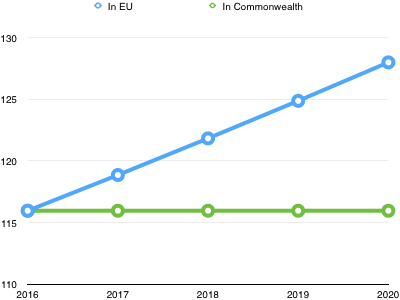
Pensioners who move abroad to Australia, Canada, New Zealand and elsewhere have their UK state pension frozen – the green line below. But pensioners who move to any other EU country get the same annual increases as if they stayed in the UK – the blue line below. Currently the annual increase is a guaranteed minimum of 2.5 per cent.

Pensions Graph - EU & Commonwealth

There is speculation that the EU referendum will focus on non-treaty agreements such as the mutual recognition of welfare benefits. So-called “British welfare for British people”. We can expect a steady flow of tabloid newspaper articles with headlines like, “Large criminal family from EU gets £400 a week plus new house by social workers”.

So, removing mutual recognition of welfare systems could be the result of the EU referendum, which then opens the door to freezing the state pension for people living anywhere outside the UK, including popular warmer EU destinations such as France and Spain.

British welfare for British people – versus – the free movement of disabled people

Disabled people might lose the most in the UK referendum on EU membership. Here is how it might happen.

The early signs after the UK general election are that the promised referendum on EU membership will be framed by a political message of “British welfare for British people“.

The logic for the UK in framing the debate around welfare payments is that none of the other 27 countries in the EU want a new treaty, so it is politically impossible to change the wider fundamentals. Because the system of welfare payments is decided country by country, not at the EU level, it is possible to avoid asking for a new treaty.

The two main principles in welfare benefits at the EU level are non-discrimination and mutual recognition. A common example is that a British pensioner living in Spain will still get their British pension. The issue of non-discrimination is very important to the EU.

An example is the winter fuel payments given to pensioners. The UK is allowed by EU treaty to say that payments will be made when the temperature drops below a certain figure. It is not allowed to say that such payments will be paid to pensioners but only if they live in the UK.

The effect may be similar, that people living in warmer areas don’t get the extra heating payment. But the logic is about warmth, and must not be about discriminating against their movement to another country.

But the UK referendum could try to change this. This is speculation, but the change could be to say that EU citizens moving into the UK cannot have “recourse to public funds” for a number of years. So, you can continue to come here if you are rich but not if you are poor and were getting some assistance where you used to live.

An example would be a care package for a disabled person. You might feel that it is already the devil’s own job to keep your care package when you move from one borough to another, or from one part of the country to another. Moving with a care package to another EU country is already even more difficult. It might soon become impossible.

In the UK we could end up in a position where we say to EU disabled people: you are welcome here … but let’s see your money first.

And it doesn’t take a crystal ball to guess that other countries will then say to very same thing to British disabled people wanting to live elsewhere in the EU.

A solution could be that all countries agree, say, to pay for care packages up to two years of living abroad, after which it passes over to the new country. But just one example here – NHS prescriptions to people who are living abroad stop after three months, and with austerity it is unlikely that the UK would increase entitlements as part of the negotiations.

The early signs after the UK general election are that the promised referendum on EU membership will be held sooner in 2016, not 2017.

The logic for moving the date is to avoid prolonging the agony of endless debate and argument. An early date also reduces the time when many EU processes are put ‘on hold’ while we wait for the result of the vote.

But there might not be a lot of time left to campaign for disabled people’s rights to move around the EU as freely as non-disabled people can.

Decoupled Growth: turning the economic lights from red to green

There is a lot of commentary ‘out there’ at the moment on the party manifestos ahead of the general election next month. Some of these comments have basically summarised the Green party manifesto as ‘just Labour, but more left wing’ – higher taxes, higher spending, larger public sector, ending austerity. Maybe.

But a fundamental divide remains when we look at economic growth. Most parties want to promote it – “to share the proceeds of growth” – and it provides politicians with a ready answer to journalists asking where will the money will come from for today’s promises. However, the Green party manifesto says they reject GDP growth entirely as a policy objective, and if in power would be happy to see it flatline.

Decoupling Growth: should it be done?

Some of the greener elements within the Labour party have, quietly and for a while now, been talking about decoupling growth from carbon. This approach allows for increasing GDP, but with a switch to renewable energy and low-or-no carbon technologies. But it is one thing to decouple GDP from carbon; it is something much bigger altogether to decouple it from economic policy.

Other economists, and not all of them green, point to our changing world. They highlight the trend over recent decades from there being just one or two super-powers to a “multi-polar” world where countries such as China and India have a growing influence. These economists point to the massive growth in super-cities, and to population growth heading towards nine billion people. They question how every country can grow its GDP, especially when the days of cheap or exploitation imports from poor countries into rich countries are coming to an end. The oil shock in the 1970s started to teach rich countries that lesson. Areas of difficulty remain. Africa still struggles to sell its food fairly within the tariff-protected West, and there are green debates about food miles which need to be reconciled with equity debates and promoting fair trade.

But basically, we having a changing and complex world where power is shifting. We also have growing inequalities despite these massive global forces. We see large companies with more wealth than small countries. We see individuals with more wealth than whole towns or regions.

When the global financial crisis hit in full force in 2008, the Queen famously asked, “why did no-one see this coming?” Apart from a few Marxist professors choking on their cornflakes, the polite answer would have been, “well Ma’am, they did know it was coming, but it paid them to keep quiet.”

So instead some graduate mathematicians came up with a complex formula that magically confirmed that sub-prime debt can be turned into triple-A assets, and were promptly well-paid by Wall Street to work their alchemy on the balance sheets. Expensive books were written about the new, respectable “value at risk” magic formula. “You see, Ma’am, it was totally tulips.”

So growth and GDP are now damaged goods. The world probably cannot afford it, certainly in the long run. The political economist John Maynard Keynes said, “In the long run, we are all dead.” True, and not to be too gloomy but this just might be how it happens globally unless we change our ideas.

Decoupling Growth: can it be done?

To be blunt about it, GDP growth has been held out politically as the hope for the poorer person everywhere that good times are just around the corner. If that is taken away, what can they look forward to in a world of green economics?

One trick is to have your cake, and eat it too. In this example we prioritise growth in the service sector. So, we can talk about growing employment levels where people provide services to other people. Teachers, nurses, waiters, accountants, advisors and so on, ideally all on bicycles and public transport. A bit flippant, but you get the picture. The difficulty here is how to stop this growth in earnings and economic activity ‘spilling over’ into unsustainable consumption – more air travel for holidays, bigger cars, more stuff at home, and so on.

Another difficulty is that it is perfectly possible to have no growth, but also a worsening environmental balance sheet. Consider, for example, reducing the number of wind turbines in exchange for more use of shale gas or fracking. Zero growth, yet more carbon. Zero growth in itself is not green. Of course, Green party politicians will reasonably point to the rest of their manifesto (home insulations etc) as an overall benefit to the environment.

But, basically there has to be a rationing of carbon and other finite resources – by taxes or regulations or a combination of both. So, green economics would suggest lower taxes on labour and new or higher taxes on carbon.

So, could it be done? Well, we don’t know yet because no-one has yet tried it, nor even dared to suggest it. Higher taxes for rich people still seems easier to sell on the doorstep than higher carbon taxes or rationing for everyone.

How to save our town centres

Book Review

HOW TO SAVE OUR TOWN CENTRES: A radical agenda for the future of High Streets
Julian Dobson, Policy Press, 2015. ISBN: 9781447323938

Empty shops. Charity shops. Betting shops. The death and decay of our High Streets has been troubling us for at least seven years. Longer, if you live in areas like the coalfield villages in the Welsh valleys and others north of Watford. Julian Dobson has written a great book here on what has gone wrong and, more importantly, what can we now do to rejuvenate our town centres and High Streets. This is long overdue, and vital to our quality of living.

His experience and knowledge shine through in this clearly and carefully written book. For me, anyone can catch my attention when they acknowledge Jane Jacobs and her thinking on street design, and Julian doesn’t just quote her, he understands her. And though he is very measured in his writing, you do get an occasional glimpse behind the curtain. Folk working for firms of High Street lawyers might want a stiff drink before reading pages ten and eleven. And a similar caution later for university library manager friends in Sheffield.

Julian covers the ground thoroughly, reminding us of the pioneers and initiatives which still hold lessons for the future. He rightly cautions us against trying to make our High Streets into unsustainable copies of a nostalgic past. Perhaps here his biggest contribution to our understanding how our bad our High Streets have become is his forensic analysis of the British commercial property professions. There is a lot of fresh work here, and with plenty of research leads for others to usefully explore. The professional tension between risk-aversion and promoting bubble economics is laid bare.

He concludes this fine book with a section on what can be done today to improve our High Streets. These suggestions are very practical and pragmatic. Julian resists a simple solution, whether it would be a new law or a new technical fix. So there should be no excuses for waiting for someone or something else – anyone concerned with their High Street can start straight away with these improvement ideas. It is a collective enterprise, going as he says from ‘me towns’ to ‘we towns’.

I really hope that there is a second edition of this book, and soon. It would have another chapter— on how it all started getting better. Julian would be too modest to add his influence within such a chapter, but we would know.

And if I can speculate for a moment. Things only seem impossible until someone makes them happen. Cities were in decline not long ago. But consider people like Tony Wilson and Tom Bloxham. Tom was a young man starting out in business who saw that, in his own words, old buildings were cheaper to buy per square foot than carpet. Now thousands of property companies have followed the lead of pioneers in urban regeneration such as Urban Splash. It set a new normal. And if Tom rewired urban property, Tony rewired the urban brain for a new generation. Many, many helped – like a town centre, a city is a collective enterprise – but someone had to open the door.

Julian rightly describes how some areas have taken these changes to an unsustainable level, often with a mistaken belief that retail-led regeneration will solve every town centre problem. ‘Boom goggles’ he calls them. Or ‘cargo cults’, as anthropologists would describe them.

But I quietly suspect that someone, probably young, possibly with a background in video blogging, skateboarding and graphic books, even now is sitting with their mate in some greasy spoon cafe in Collyhurst and saying, “those empty shops and stuff, you know what…”

And so a door opens on our next new normal.

Using algorithms to detect fraud and find criminal behaviour

In California the owner of a firm supplying power wheelchairs paid for by the Medicare and Medi-Cal funds, was convicted on 20 March 2015 of fraud of $3.5million (1). She had been paid almost $2million, and sentencing is set for June 2015.

Fraud within public funds is not new. In the UK the programme of Individual Learning Accounts had to be abruptly closed and abandoned because of fraudulent claims by criminals using powerful computers. They searched for weaknesses in the system’s data and then made hundreds of automatic false claims on each ‘find’, each claim for over £150.

In the USA the authorities are making it known that all financial claims are now monitored by anti-fraud algorithms which look for known patterns of criminal behaviour. Clearly these algorithms are not themselves in the public domain, but common sense suggests that any statistically significant ‘spikes’ in the claims will raise a red flag.

But more important than money is life itself. The same algorithms can also be used to interrogate health data as well as health funding.

Harold (Fred) Shipman, the mass murderer, killed patients at an estimated one a month for 25 years, mostly elderly women living alone. “By 1998 … a local taxi driver, who often ferried old ladies around, noticed that they seemed to die shortly after seeing Shipman. Linda Reynolds, a nearby GP, noticed that his patients were dying three times more frequently than hers.” (2) The subsequent Inquiry determined that he murdered 210 people, plus a possible 45 others.

The Mid-Staffordshire hospital scandal of appalling local health care was also first detected by patients’ relatives who knew that something was wrong. In retrospect, the data told the story in terms of falsely coding people’s deaths. The senior managers in charge at the time tried to “explain away” these sudden lurches in unlikely deaths, but the relatives’ stories and the data supported each other and the truth emerged.

Back to funding in the UK, and at a more routine level thankfully, we have the recent convictions for fraud by some A4E staff making false claims to the Department for Work and Pensions and to the European Social Fund.

Auditors are usually well aware that – if it looks too good to be true, then it probably is suspect. Such as projects which achieve all their outputs and outcomes, with everything spot-on the original profile, along with wonderfully neat files all signed in the same shade of ink. Hmmm.

It might not be as high-tech as super-computer algorithms, but auditors as well as machines can know which trends or characteristics in the data will need further investigation.

(1) http://www.justice.gov/opa/pr/owner-medical-equipment-supply-company-convicted-35-million-medicare-and-medi-cal-fraud

(2) Forensics: an anatomy of crime, Val McDermid, 2014, p107.