Category Archives: Uncategorized

Tax and jurisdiction – after Tobin we need to keep campaigning for tax fairness

The world’s debt is now over $100 trillion, twice the global GDP. That is $100,000,000 million. Inequality within countries and between countries continues to rise. The medicine from the IMF, World Bank and European Central Bank of austerity, cuts, and privatisation has made things worse, not better.

Meanwhile every major power – USA, China, Russia, EU – has an extractive elite group which continues to rake in the money, even as local wages drop, unemployment rises and their economies stagnate.

I want to float the idea here that globalisation is a problem, not new in itself, but because it is only half-finished. We have had the liberalisation of financial markets, where funds flow in absolutely massive amounts every second from one computerised stock exchange to another. But this is tax free, making markets more powerful than governments.

There has been the proposal for a Tobin Tax, a small percentage of tax to be taken from every international flow of funds. For whatever reason this hasn’t taken hold, and vested interest by the extractive elites seems as likely a reason as any.

As an alternative, lets look at the USA. Their tax authorities have a useful tool already in use. If a US citizen anywhere in the world receives money, then the US government can tax it. There are various rules, but the principle is important because it relates to jurisdiction.

So, let us imagine that we apply this to international companies as well as individuals, and that the UK adopted a similar rule. And France. And Germany. We can imagine the chaos. So international companies play the system and cut a sweetheart deal with the most desperate or obliging country within their operations.

Now let us think about modifying this policy. You must pay tax to country A unless you can show you have paid the same amount or more tax to country B.

It is the “or more” that is important here, because it stops a tax race to the bottom.

Would it be a race to the top instead? What is to stop any government setting a tax rate of 100 percent and trying to scoop the whole bowl – well, international companies would close down their operations in that territory.

So, imagine the EU governments agreeing a tax treaty on these lines, which would make a massive difference because they together are economically large enough in the world – they have market power.

In the film, The Day After Tomorrow, there is a scene in New York Central Library where the school pupils and others need to light a fire and keep warm until help arrives. They are uneasy about burning books until one of them finds shelves and shelves of books on tax law.

Maybe these tax books might also save the world, yes economically, but still with a massive human cost as we continue to get it wrong.

Brexit was an intellectual failure. What should we do now?

The UK vote in 2016 to leave the EU was an intellectual failure, and now the intellectual class risks paying a high price. Universities in particular will lose many overseas students, and not just from the EU. Businesses will lose international employees similarly. Xenophobia and racism are encouraged by some powerful politicians and hate crimes are rising.

We need to understand the intellectual failures behind these changes if we are going to start to remedy the situation.

To start with, we have to go back a little. Eleven years before the Brexit vote the French people had voted similarly, but in classic terms the outcome was fudged.

In May 2005 there was a referendum in France on a proposed single text which would become the new constitution for the EU. The Parisian elite and the main parties were all for it. It had been drafted by a former president, Valéry Giscard d’Estaing. However the French people disobeyed their betters and voted No.

Of course, France did not leave the EU. Instead the idea of a constitution was quietly dropped and the powers-that-be pretended it had never happened.

In his analysis of this 2005 revolt, published a year before the Brexit vote, Sudhir Hazareesingh (an Oxford professor) sets out the main currents of discontent that washed across the land: xenophobia and racism concerning enlargement of the EU, hostility from the regions set against the capital elite, and a backlash against multiculturalism with it being seen as an attack on French identity.

Consider the following, exactly as it was published over a year ago:

“Indeed, what was most striking about the victorious ‘No’ vote was its effective aggregation of negatives. Upon the classic eurosceptic fear of loss of sovereignty was grafted a toxic combination of populisms: a xenophobic rejection of European enlargement, a progressive anxiety about the dilution of French social rights (represented by the figure of the ‘Polish plumber’) and a neo-Poujadist rejection of Paris-elites by grass-roots campaigners. As Jean Monnet’s star began to wane, the unlikely hero of the moment was Étienne Chouard, an economics and management schoolteacher who mounted a widely consulted campaign against the European constitution on his website. Libération hailed him as the ‘internet champion’ of the opposition campaign, and Le Monde devoted an article to the ‘Don Quixote of the “No” vote’. It was a measure of the impotence of the Parisian intellocracy (but also, conversely, of the growing power of the new horizontal age of internet communication) that the European project, the brainchild of Jean Monnet and one of the most distinguished creations of Gallic thought, was thus effectively pushed to one side by a blogger from Marseille.” (How the French Think, Sudhir Hazareesingh, 2015)

You rather wish someone had bought a copy and left it open on page 247 on the Prime Minister’s desk. Oh, what might have been…

But in truth by the time he could have read this book it was already too late. Promises had been made and changing course would have destroyed the Conservative party. Nor would it have helped the Labour party, which then still believed that ‘Europe’ would destroy the irreconcilable Conservatives either way, bringing Labour back into power using the buggins turn method of UK democracy. The intellectual strategy, in effect, was to sit, watch, and wait.

The Scottish National Party annihilation of the Labour vote in 2015 was more than a straw in the wind. Like a taser, that result sent an electric shock through the Labour party, collapsing it to the ground. And every time Labour MPs gathered in the House of Commons, the sight of so many SNP members sitting where Labour people used to be sat sent shudders anew. The strategy (if that) of watching and waiting was now replaced by one of twitching and fearing.

At a deeper level, the Labour party also became irreconcilable. ‘Europe’ was part of that mix, but much smaller than for the Conservatives. For Labour, the divide was over the EU’s legal privileges given to market forces and a fear this private sector bias will damage health, railways, postal deliveries and other public services, as well as holding back state help to firms in steel, coal and other stressed industries. New Labour grandees were worried about losing their reputation for being pro-business. Old Labour grandees similarly worried about losing their internationalist credentials if they criticised the EU.

But the main fault line was that many Labour leaders had lost their followers. The change in membership rules had created the largest party in western Europe, a new membership that was increasingly at odds with the old leadership. A leadership which had to fall back on the argument that half a million people were wrong, because the wider electorate would never support their policies. This was becoming mathematically a less sustainable argument as new members continued to join.

An this is where the intellectual failure bites. When Michael Gove now famously declared that “the British people have had enough of experts” it had the perhaps unintended effect of letting experts feel that at least they had done their bit. They had tried, they told themselves, but it was just unfortunate that they had been shot down.

But what had the experts, the intellectuals, actually said? The blunt truth is that most of the expert statements were from economists making predictions about the economic impact of a No vote, which was incorrectly but very effectively typecast as Project Fear. Which, incidentally, was forensically analysed in The European newspaper which tracked the UK tabloid front pages in the run-up to the referendum for relentless scare stories about immigration, entitled The Real Project Fear.

So we had expert economists, who to be fair did willingly enter the fray even though they left battered. But where were the rest of the experts, the intellectuals? There were a few round robin letters printed in the broadsheet newspapers, from university vice chancellors and the like, but nothing that frankly might really set the debate alight.

A lot of energy is now being given to speculating about the Brexit negotiations with the EU27. Perhaps we should save our breath. Basically, by March 2017 the UK will write a letter saying it is leaving, and by March 2019 it will be gone. There is a view held by some British people that there will be much to negotiate. However it is clear already that the EU27 think otherwise. UK politicians know that they are on the back foot, despite publicly denying it, so they resort to threats about EU nationals in the UK not keeping their right to remain. The Spanish government has already responded this week with claims for funding from the UK for the health care costs of hundreds of thousands of British pensioners currently living in Spain. Pensioners, by the way, who are ‘ex-pats’ and definitely not immigrants. Both the Daily Mail and the Express have print editions in Spain. Their contortions will be one of the few pleasures to be had from Brexit.

So intellectuals should enter the battle at last, bluntly, but not be drawn into the negotiations speculation sideshow.

The task instead is to start again with the case for internationalism, for peace, for solidarity, for equity between countries, between regions and between communities. This will mean a hard look at what is currently on offer: at globalisation, at the extractions done by financial markets including London, at the European Central Bank’s fights with eurozone countries, and at the priviledged position given within the EU to market forces. And it means doing this rebuilding and reforming of our shared institutions with people in other countries, not to them.

Finally, take heart. Remember the cotton workers in Lancashire who boycotted the pro-slavery southern US states even though it cost them and their families dearly – for justice and for international solidarity. Remember president Lincoln’s deep gratitude to them. Remember change can be argued for and won. And we have a good start at 48%.

The Way Back, by Maggie Hines, 1983

This article first appeared in a newsletter of the Derbyshire Coalition of Disabled People. Maggie Hines later became known as Maggie Davis. It was found again in 2016 in files at the Greater Manchester Coalition of Disabled People.

If you are severely physically impaired and need the help of another human being to survive, you have all the potential for incarceration in institutional care. We live in a society which is built on the assumption that the family is the right and proper source of help. Institutions operate as a social defence mechanism to protect this general assumption. Inevitably in a society which provides minimal family support services, the stress on families operating as sole carers leads inexorably to breakdown and the incarceration of the person who is physically impaired.

It may seem strange to commence an article about housing for physically impaired people with a statement about care. But the fact is that the more severe the impairment, the greater the likelihood of dependence on other people and the less likely that housing per se will satisfy the conditions for social integration. Housing, however well designed, however well equipped with gadgetry will never meet the needs of dependent physically impaired people. Housing and help are inextricably linked and must be consistently perceived in this way if physically impaired people are ever to achieve a secure base for full participation in our society.

In my case, following the accident which led to my own physical impairment, the question of family breakdown under the stress of caring for my needs did not actually arise. One parent was dead and the other too frail to cope with my needs. Then, as now, there were no adequate domiciliary support services. Apart from the community nurse, help provided by the Local Authority was purely discretionary, since my accident was before the 1970 Chronically Sick and Disabled Persons Act. Indeed, before my accident I was working as a nurse and never challenged this situation. I assumed, like most do, that our social welfare provision was sufficiently all embracing and that if people did end up in institutions by virtue of their age, mental or physical condition, then surely this was the right and proper place for them. The only time I ever encountered the suggestion that the way we did things was not the perfect model was while nursing in the Lebanon, where dependent family members were contained within the extended family rather than in more formal social solutions. By and large my attitudes were those of the average professional in health and social welfare; those physically impaired people I encountered were seen as cases or patients based on the medical model and not as people who just happened to have a condition.

My awakening began in a very real sense when I found myself on the other side of the fence. I found myself on the receiving end of the very same attitudes and perceptions I had been carrying around with me. I can’t say I liked it very much. However, having survived the acute stage of my paralysis in hospital, further rude awakenings were in store. There were no houses for people like me, no flexible system of domiciliary supports comprehensive enough for anyone as physically impaired as me. Since my family could not cope and indeed, my wish was not to go back to parental care, I was swept neatly into the nearest institution. It was there that I really began to wake up to the oppressive social relations existing in society and it’s impaired members. I hadn’t realised that in a split second I could be switched from being an able-bodied first class citizen to a disabled second class citizen with all the implications that carries with it.

Institutions were places people like me died in. The longer I lived there the more I realised I was one of society’s social outcasts thrown onto the ultimate human scrap heap. I resented the devaluing and dehumanising regime. It was impossible for me to accept this form of accommodation and care as being an acceptable substitute for housing and help in the community. Society had incarcerated me because they thought and still do – that institutions were the right places for people like me. For me the natural place was out there in society playing an active part, as I had always done, in the community. We are social beings, it is offensive and wrong to remove us from society and treat us as sub-humans. It was like being sentenced to life imprisonment without trial, and in this case, life means precisely what it says for most people, with no chance for parole or remission for good behaviour.

The way back was long and tedious. I had begun to see along with many other physically impaired people, that we needed to come together, get organised and develop unity of purpose. When Paul Hunt publicly suggested that we should come together in this way it was a lifeline to me. The Union of the Physically Impaired Against Segregation was formed and, as it developed, many things about my situation came clear to me. I could see that I and my fellow inmates were victims of other peoples’ prescribed solutions to our problem. What was needed was that physically impaired people should define their own problems and their solutions out of their own direct experience of disability. We needed to get back into society with real control over our lives. Of course we need help, but I could see that existing service providers (among whose number I had so recently been) must become a resource to be drawn on by those in need of help. This would mean a radical change: the professionals’ prescription of stock solutions to our need of help had to be replaced. But the idea of our service providers actually lending themselves as a resource under the direction of their so called patients or clients is still a long way off.

The solution to my immediate housing / help needs had to be struggled for in advanced of these required changes. When I met my husband-to-be we set about devising our own alternative to institutions and the principles on which it ought to be founded. That we were able to achieve what we wanted says a lot for the individuals with whom we worked along the way. Our answer was a small development of housing units, some of which were designed with the architect to meet the specific needs of their potential tenants identified in advance. Other units were to be let to non-disabled tenants who were willing to supplement the help available from local domiciliary services in meeting our need for support. This quasi-collective solution [was] against the institutional reality forced on us by other people.

The Grove Road Scheme in Sutton-in-Ashfield has subsequently offered a pointer to other people seeking an alternative to institutions. The approach is simple enough: it rests on the premise that physically impaired people should be fully participating citizens integral with their local community. It shows that there is nothing particularly special required except a willingness on the part of the service providers to work with us in designing and developing ‘independent living’ arrangements. It suggests first, that the basic design of a house should be evolved out of the dialogue between architect and disabled person. Second, that aids to independent living should be provided with the housing to reduce artificial dependency on human resources. Thirdly, that a system of help is required that ‘spreads the load’ so that no one source bears the sole burden of care.

Statutory sources of domiciliary help can have a valuable underpinning and stabilising effect providing that they are responsive to the requirements of the disabled person concerned. But it is essential that support systems are socialised further than this, drawing on the resources available out of normal neighbourhood relations. This has the effect of removing from the family the burden of being the sole carer and increases the general level of awareness of the community about the needs of the disabled person and the needs of the carer. in this respect, the ideas of DCDP [Derbyshire Coalition of Disabled People] are very important. Practical progress is already being made towards a county-wide Care Attendants’ Register – at the time of writing a pilot project at Clay Cross is in the final stages of planning. How far Social Services see this Register as a part of a spectrum of domiciliary help rather than a convenient method of shedding, as opposed to sharing, the load, remains to be seen. But there is no doubt integrated independent living is [on] the way and will provide a real choice for the first time for even the most severely physically impaired person. It’s the start of a process which will spell goodbye to the segregated residential institutions as we have known them as they are thrown into the garbage can of history.

M. H.

******************************

Disabled people’s organisations and archives

First written in November 2016 

On references

Please note, this is a blog posting so there are not extensive academic references to support each point or assertion made in the discussion.

Introduction

History is more than a list of dates with the names of kings and queens. We know that social histories are important. We understand now that knowing a shared history is part of what defines the identity of any community. Yet for disabled people’s organisations (DPOs) across England at least, the collection, preservation and transmission of social histories has been neglected and under-resourced.

This article suggests and discusses some of the reasons for this neglect, and describes some of the main actions needed to start to make improvements happen.

The format of this article is in five sections:

  1. cultures,
  2. strategies,
  3. policies,
  4. practicalities, and
  5. access.

Some readers might wish to concentrate on just a few of these areas rather than taking in all of the discussions.

Much of what is written here is based on three sets of personal experiences. Firstly, there are here reflections and lessons from the experience of trying to improve the records of the Greater Manchester Coalition of Disabled People (GMCDP) in 2016 with professional assistance from the staff at Archives+ within the Central Library of Manchester City Council in the UK. At the time of writing this improvement is still a work in progress, in transit from being a store room to being 165 catalogued boxes of mostly documents, and then to be taken into a fully functioning and secure archive.

The second set of experiences are around working with friends and family members of disabled activists who have died. It is public knowledge that one of these campaigners was Kevin Hyett, and privately some other families and friends are also being assisted. It will be for those families to decide if any, and how much, of the personal collections of deceased campaigners are to be shared, and with what safeguards or conditions on their use.

Finally, the third set of experiences come from my research for an MPhil in acknowledging the histories of some DPOs through their old photographs, which was done part-time from 2004 to 2012 and later published for free online.

Section 1: Cultures

There is extensive research on the lack of acknowledgement within mainstream cultural channels (museums, libraries, archives, public broadcasting) of so-called minority histories, although there are also great examples of good practice. The critical research in this area is often based on emancipatory principles, including feminist analyses and voices with the direct experience of oppression.

The classic example is how women, more so than men, are the custodians of the family album of photographs. Young children are sat on the knee, the album in hand, with the stories told as the pages are turned. An oral tradition of family knowledge transmitted, enduring within the family but fragile beyond it.

Similarly oppressed communities would weave a shared narrative, such as are told in church, temple and mosque sermons, in huddles in the corners of cafes and pubs, and at the back of the room at large weddings. However, for disabled people to opportunities to gather together and share stories and histories are fewer.

And as well as mainstream cultural knowledge being filtered, it is also becoming more of a commodity. The days of the university library open to all visitors are gone, the library is now part of “the offer” made to paying student customers, as well as being a source of income for academic publishers who take knowledge – publicly produced, and freely written and reviewed – behind an internet paywall. Making data private, sometimes including donated archival documents, creates a licence to the new “owners” of the data to exploit the intellectual property rights (IPR) opportunities – and yes, some universities do use exactly these types of phrases.

Section 2: Strategies

A typical conversation in the office of a DPO might go as follows:

“This filing cabinet, it is getting too full now.”
“Yes?”
“We don’t need most of the files any more. Where shall I put them?”
“Oh right, put them over there, that corner. Anywhere you can. That is our archive.”

At the risk of being too blunt, calling a pile “an archive” doesn’t make it happen. The start of change is to name things for what they are. So, it is really a store room, a cupboard, a cabinet, a pile. And it is a precious collection beyond words but it is not an archive. Not yet.

There is something about managing an archive that causes many organisations to run into difficulties, and DPOs are no exception here. Some of the reasons are probably based in a fear of getting it wrong. Increasingly these days the sheer pressure of direct funding cuts and other reducing resources (such as fewer local libraries and librarians) plus the added pressures on disabled people losing social care, benefits and scarce employment; all these pressures mean that managing an archive cannot be the highest priority for a DPO.

But I would argue it should be a high priority, if only for one reason – that learning from the past will make today’s campaigns at least twice as effective. How did DPOs fight the cuts in the 1980s? How did DPOs campaign so that Parliament eventually passed a law on civil rights in 1995 after years of refusing to do so? How did DPOs get access to driving adapted cars in the 1940s? How did DPOs first campaign for national insurance? Precious lessons.

And yes, today we have Facebook and Twitter. Which, by the way, are a problem for future archivists, but more of that later. But do we really believe that campaigning only started when the Like and Retweet buttons were invented – of course not.

Section 3: Policies

So an archive has valuable lessons and advantages for today’s campaigns, and there are three key policy documents that govern the construction of an archive: the collections policy, the donor agreement, and the user licence.

The collections policy is a set of written guidelines on what the archive will and will not hold. No archive should be used to collect just anything interesting at random, because it makes a nonsense of the archive. Every archive has a purpose, for example to hold records of disabled people’s campaigns and organisations in Greater Manchester, or Birmingham, or elsewhere. Nor will an archive hold every possible piece of paper: for example few archives will keep financial records such as invoices and purchase orders, as they usually have minimal historical value, in contrast to membership records or copies of newsletters which have strong historical interest

As an example, organisations are usually legally required to keep records for seven years, after which they can be destroyed. This rule applies to UK ordinary tax records. At another level, a commercial organisation had a policy of keeping their personnel records until the individuals 80th birthday. But if the seven year rule is the usual one, then a collections policy might include the practice that the archive team will receive all the files no longer required by the organisation, usually once a year, and will decide which are worthwhile for addition (acquisition) into the archive and which are not of merit and are to be destroyed. Staff travel expenses sheets have no particular merit, but the Annual Report will be significant.

The donor agreement is a signed record of any donation of materials and is key to showing the correct provenance or previous ownership/s of an item, as well as setting out who an item belongs to now and whether there are to be any restrictions on its future use. Some archives will always require a full donation, while some others allow for long-term loans (“deposits”) of items as well

Care needs to be taken on the terms and conditions which will apply to the users of the archive. One example is the Creative Commons set of standard licences. One of these licences allows users to make copies of any item provided these copies are not for sale and that the original source is acknowledged. A downside of a Creative Commons licence is that it is deliberately inclusive which can lead to materials being appropriated by organisations and causes which might have little or no connection to the DPO and its aims. The writer of this article found that some of his photographs of disabled people demonstrating for access to buses, which are held in an archive as well as being online, were later used by a disability organisation in a national newspaper to wrongly imply that the organisation had been connected with the radical demonstrations being shown.

Section 4: Practicalities

Doctors are taught, first do no harm. People sorting out archives should follow the same principle. Avoid the temptation to make everything look neat and tidy. An example would be opening every file and taking out any photographs, putting them in a separate box. It seems very organised, but the archive has lost valuable information. Few organisations write all the relevant details on the back of each photographic print, and very often the only way to make sense of a picture is from the other documents it is stored with that provide a probable context.

Nor is it necessary to put everything in date order, or theme order, or whatever. The key point here is to make an item findable. The finding tool will be the catalogue, and a computer search of a catalogue is the most powerful tool an archive can have. So a user will type in a search for “independent living” and “benefit cuts” and the catalogue will as a minimum say “box 23, file 4, item 17”. Depending how much work has been done with the archive, the finding tool might also say “and here is a pdf copy of that item”.

Keeping the original order of items is also important for future research. For example, we can imagine that in ten years time a researcher will go through archive box 23 item by item and spot a pattern that no-one had seen before, such as half of the disabled people in a campaigning group were also members of the same sports club. Maybe it had been remarked on at the time but never formalised because no-one had thought it to be noteworthy. More often, a future researcher will note the gaps in the records, such as where are young people, or where are Black people in all of this?

A key point from the above discussion is that the overall quality of the entries that make up the catalogue, the finding tool, is a major factor in how useful an archive is. As an extreme example, go back to our stacked piles of files and boxes on the floor in a storage room. A researcher arrives and asks the staff, “Do you have records of cuts campaigns in the 1970s?” to which someone says, “Oh yes, have a look in here” and opens the door.

The catalogue entry needs to be as detailed as possible, and dates are especially helpful. Sometimes an exact date is known, for example the date the copy of a letter. Sometimes it is more vague, such as a newsletter which says “Summer 1987” or “March / April 1992”. Sometimes the best you can do with an undated document is mark it in pencil as “c.1972” ( c. or circa is Latin and means around ) based on reading it and knowing some of the context. It is very helpful to include any vague date material within the title of an item, as well as in the box or field for a date. “n.d.” means no date is known.

In an era of the internet, electronic records and paperless offices, it is perhaps humbling to recognise the physical endurance of paper. There are books which are hundreds of years old, scrolls found in caves which are thousands of years old, and papyrus records from early Egyptian society. Yet we have documents written as recently as in the 1990s that are already becoming lost for ever, stored on floppy disks which have decayed beyond use and printed on now-faded thermal paper.

The UK National Archives and similar bodies in other countries have recognised this development in part, and have captured in time a wide range of websites for future reference. But the world of Facebook and Twitter risks becoming “the next thermal paper,” where the social histories of campaigns become lost in the moment. It will be interesting to see how archivists respond to this new need for online record keeping.

A range of tasks for volunteers and staff

The basics, or Level 1 tasks

Protect the materials from sudden loss, such as damage from water leaks, insects, fire and smoke damage, or theft. Remove the hazard, or move the materials away from the hazard to a better location.

If the material is in open piles, store the materials in metal filing cabinets, metal cupboards, or on open shelving in boxes, in the same order as found in the piles. Keep them in a locked room.

Try not to be overwhelmed by the scale of the tasks. People will have tried before to bring some order to the collection, and there may be packing lists or indexes of files which you can usefully work from. Throw away nothing and re-order nothing at this stage. Every list will have clues and pointers to the contents, including valuable contextual information about when the items were created, where they came from, and who might know some more about them.

Level 2 tasks

Make a list of the materials. This can start as high level, such as “a box of newsletters from 1994” and this basic list can grow in time to become a more detailed list of each item. It is helpful later on if the list is made using a spreadsheet program.

Store the materials in the same order you found them, and avoid the temptation to re-arrange them into date order, or any other type of imposed order.

Remove any PVC (polyvinyl chloride) plastics, such as document sleeves or wallets, from the collection. Replace them if necessary with clear polyester or polypropylene sleeves and wallets. Staples and pins should be removed from older papers, and only brass paperclips should be used to avoid staining the papers. Storage boxes should be acid-free and archival quality. Boxes are the recommended way of preventing damage to papers from sunlight, smoke, and over-handling.

Take photographs or photocopies of any items which appear to be deteriorating, such as documents on thermal paper where the print is already fading away. Print these copies on ordinary acid-free paper and store alongside the fading original.

Level 3 tasks

Look for a good quality permanent home for the collection of items. Ideally such a home will be a staffed archive which follows the national standards set out by The National Archives. A good archive room will have no strong sunlight, no water pipes, metal furniture, an even 15C to 17C temperature, steady medium humidity (50% – 60%), plenty of space to avoid dangerous stacking, with good air circulation, and strictly controlled access.

Some items such as photographic prints may require a much lower temperature to keep them chemically stable, and some items (including some very old types of film negatives) may require freezing, for example to stop infested insect eggs from hatching in paper.

If you need to mark the materials in any way, for example to add a date, then write using a very soft pencil, such as a 6B pencil available from art shops. Use clean hands, and wear thin cotton gloves if the materials are very old or rare.

If you need to make digital copies of items such as documents and photographs, try to use a camera rather than a scanner with a paper feed mechanism, unless the documents are recent and robust. There is a risk that a feed mechanism will tear and damage any fragile items.

Backups of the digital copies must be kept safely offline, away from internet hackers, viruses, etc. All digital items need to be transferred to a new medium every ten years, otherwise the recording medium (for example, CDs, hard disks) will deteriorate and lose the digital files.

All these tasks help in the preservation of materials within the archive. The final stage is known as conservation, which moves on from passive measures to active measures which aim to prolong the life of items. Conservation is the professional repair and treatment of items which will deteriorate unless a remedy is applied.

Section 5: Access

In the archive profession, much of the discussion under the title of access tends to be about opening hours and arrangements to make sure that visitors do not damage or steal the materials they are handling. In this article, access means the wider political issues of disabled people’s access to knowledge in their required formats.

We have seen how paper is one of the most resilient carriers of storing information. However, many people are print-disabled, including disabled people with visual impairments, with dyslexia, and with learning difficulties.

It is now technically possible to make a lot of archive materials more widely accessible using scanners and computers. The basic stages are:

– scan the document and create a digital format, usually PDF,
– process the PDF with OCR (optical character recognition) software to convert the shapes into digital words and add the digital words back into the PDF, and
– use screen readers to speak the words on the screen for print-disabled users.

This process enhances the archive, making its contents more accessible now than when the documents were first created. It is also a universal method, so it does not require access to any other software, such as now-defunct desktop publishing programs or old word processors. Everything is taken from the shapes on the paper, and OCR software these days is capable of handling headlines, multiple columns, page headings and numbers, and tinted paper backgrounds, but not cartoons and images.

Probably the largest organisation creating accessible archives using OCR software is the Internet Archive, (www.archive.org) a nonprofit organisation based in San Francisco, California, with millions of older books already converted and made available to US citizens within the laws of US copyright. Their process is known as DAISY – the Digital Accessible Information System format

The archives of DPOs in the UK, as well as libraries and archives generally, could usefully follow the initiative of Internet Archive.

Discussion

To follow one day, the idea is of a network of disability and DPOs archives and collections in the UK, including maybe Belfast, Birmingham, Cardiff, Derbyshire, Edinburgh, Hampshire, Leeds, Liverpool, London, Manchester, and all online as far as possible.

Credits

Every project is a team effort and this is no exception. Many people, maybe fifty or more, have contributed in some way to the work in progress that is the GMCDP archiving project, and many names will be found in the catalogue. If we just consider those people who have attended archive project meetings, written reports, or had some direct involvement in donating materials, then credit must include the following:

Colin Barnes, Huda Bashara, Caron Blake, Angharad Beckett, Jane Campbell, David Govier, Lorraine Gradwell, Maggie Griffiths, Brian Hilton, Brian Kokoruwe, Natalie Markham, Linda Marsh, Martin Pagel, Anne Plumb, Alan Roulstone, Audrey Stanton, Dorothy Whitaker, Joe Whittaker.

We must also acknowledge here those disabled campaigners within GMCDP who, now deceased, have left a range of rare and unique items in their personal and work-generated collections for others to learn from:

Cathy Avison, Alison Blake, Kevin Hyett, Ken Lumb, Angela Madeley, Ian Stanton, Neville Strowger.

If there are others missing here, I’d welcome a correction and apologise in advance.

—-

Appendix – Creating a GMCDP Archive

[Extracts from GMCDP Briefing Notes, June 2016]

Background

GMCDP has wanted an archive for at least 14 years, and since 2002 an archive has been one of the five top priorities for the Executive Council. A detailed timeline is available from the office.

In 2005 GMCDP stored around 40 boxes at the Greater Manchester County Records Office (GMCRO). In 2014 Archives+ opened to visitors, now a combination of Manchester Libraries, GMCRO, the North West Film Archive, the Ahmed Iqbal Ullah Race Relations Trust Archive and others. Those 40 boxes from GMCDP are currently stored in Archives+.

When GMCDP moved to smaller offices in 2013 a large number of old files were placed in a storage room. This storage room also includes a number of boxes with historic items donated by disabled individuals and by disabled people’s organisations across Britain.

Three main concerns have been raised by GMCDP members about the possible running of an archive:

1. For how long would items be safely stored, such as for 100 years or more?
2. Who would own the items, and must GMCDP give the items away for ever?
3. How can we be sure that the items will not be misused, for example by big charities not controlled by disabled people?

It now appears that a satisfactory solution to all these concerns might be possible.

Recent developments

A GMCDP volunteer has been sorting through and organising these boxes in the storage room, starting to catalogue their contents and adding to the previous work done by other members. This storage covers around 70 boxes and over 20 drawers of files.

GMCDP staff have been in contact with staff at Archives+ which is based at the Central Library in St Peter’s Square, run by Manchester City Council. A good relationship has been establised.

GMCDP staff have worked on disabled people’s campaigning histories with researchers at the Manchester Metropolitan University and with Archives+. Disabled young people have been supported to produce The Accessibles publication and exhibition on the recent history of campaigning for a fully accessible city.

Early discussions with Archives+ staff indicate that:

1. While there are no absolute guarantees, Archives+ are fully geared up to hold items indefinitely, including many items for over 100 years.
2. Items are only loaned, or lodged, with Archives+ and not donated so they can be taken back at any time in the future.
3. Archives+ are keen to work in partnership with GMCDP and are open to talking further about an Advisory Group or similar arrangement where disabled people meet with their staff regularly to discuss the best use of the items in the archive.

Next stages

GMCDP Officers and staff will meet staff at Archives+ to develop a more detailed partnership way forward that is acceptable to both organisations

If these discussions are successful GMCDP Executive Council will consider lodging the remainder of its historic storage boxes with Archives+.
….

Archive Catalogue

Every archive needs a catalogue if it is to be used to its full potential, otherwise the search for relevant items is often a matter of browsing through boxes. A catalogue also allows the archive to be searched remotely before a visit is arranged.

The building blocks to make an accurate catalogue of the GMCDP Archive are now in place. This currently incomplete catalogue is spread across four connected lists –

(1) this is of around 5,400 items thought to be in the boxes held at the Manchester Central Library in Archives+, each item’s details being a line in a spreadsheet.

(2) this is an estimated further 2,000 items thought to be in the boxes held at the Manchester Central Library in Archives+, each item’s details being a line handwritten on 82 sheets of A4 paper. GMCDP currently does not have the administrative resources to type these entries into a spreadsheet.

(3) this is a high-level list of around 70 boxes of various materials held in storage by GMCDP [in storage] …. This list is not fully itemised, and currently summarises only the general themes of the contents in each box.

(4) this is a high-level list of around 25 drawers of archived materials held in storage by GMCDP [in storage] …. This list is not fully itemised, and currently summarises the general themes of the contents in each drawer. When some or all of these contents are later transferred to archive boxes, the number of boxes might be different to the number of drawers.
….

Technical Notes

The use of a spreadsheet for an archive catalogue is a preferred method by Archives+ staff because the list can be automatically added to their searchable database. The minimum information usually needed for an archive catalogue is known to archive staff as the “Dublin Core”.
Millennial Leadership – less capture and more reconstruction

The metaphor of a political earthquake is over used, but already 2016 is a political year where it can be properly said. We have seen the shaking institutions, from the EU and Brexit to Theresa May’s new government to Jeremy Corbyn and the Labour Party.

But to understand the shaking institutions we need to talk about the growing pressures deep below, growing over years until something has to give. Pressures such as – increasing inequality, wage stagnation and decline, ultra long working hours and commutes, unaffordable housing costs, student debt, climate change, species extinctions, food banks, social care cuts and the NHS in a permanent winter. A mess.

It seems to me that the general style of leadership practiced in recent years has been failing to deal with the mess. Let’s call it capture leadership.

This capture leadership has been the prevailing model for the last 30 to 40 years, for examples:
– capture a public organisation and privatise it to sell off assets
– capture a company management team and self-award big pay rises
– capture a media outlet to promote an agenda
– capture a party machine to further that agenda.

This capturing model is not just about now – the extraordinary political summer of 2016. It has been happening repeatedly such as with David Cameron in 2005, with New Labour in the 1990s, with the Social Democrats merging with the Liberals in the 1980s. Each successor took courage from the previous example, and for many years the capture model of leadership went from strength to strength.

It wasn’t all bad, but below the surface the pressures of its contradictions continued to grow and in the end these deep forces have severely shaken the surface institutions, leaving only hollow structures in their place. The model of capture leadership was always short-term, was always subtractive, whether it was asset stripping, pay stripping, or vote stripping.

The alternative leadership model I would suggest is reconstructive.

This is additive leadership, it aims to leave an organisation better than it found it. It is optimistic, visionary, inclusive. It understands the damage that has happened and has a new culture and strategy to make good change happen. It is hard work and needs careful thinking. Being reconstructive, it does mean dealing with toxic legacies and mistakes, and importantly it means incorporating these lessons learnt within the reconstruction and not just leaving them in a pile in the corner.

Reconstructive leadership is not about offering a replacement of what has gone – more of the old – because that just delays and denies change and increases the pressures.

Nor is it a displacement – it’s our turn now, we are in charge and your turn willcome later – because that just shares the captured organisation with a complicit opponent.

The risk today is that reconstructive leadership is just too difficult. Capture leadership is always easier to do – I’m in charge now, so give me the keys and the company credit card. Reconstructive leadership is harder – we are in charge now, so come in and let’s get round the table to sort this mess.

Is there a left Brexit?

The essence of Brexit was commonly seen as a right-wing project, and essentially focused on immigration. And this project struck a chord with so-called Labour voters in so-called Labour traditional heartlands.

I say so-called because actually the Labour vote in such areas has been in decline for a number of years. Plus the routing of Labour in Scotland.

All familiar stuff, but what would a left-wing exit from the EU look like?

So far we have, from various quarters, basically a bit of a shopping list:
1. protect workers rights
2. protect the environment
3. allow state aid to companies
4. remove market forces from public services
5. continue with EU educational and research networks.

On the free movement of people it gets a bit more vague. Something along the lines of – yes to free movement but with conditions on higher wage rates and local advertising.

Yet every indication so far is that the negotiations for Brexit will be for single market access in goods and services, with London’s financial services being the likely sticking point.

On this scenario we could have a future where UK firms manufacture two standards of, say, kettles. The CE standard will be allowed to be sold within the EU. The lower, rougher, cruder (though not necessarily cheaper) UK standard kettle will be allowed for British sales only. Free market rules. Fewer rights, such as removing working time limits. Less mutual recognition of social rights such as pensions and health care.

Perhaps we can start a new, more positive conversation. Let’s take the above shopping list as a good start but also consider these ideas as well:

6. free movement of people
7. a minimum income based on adult citizenship
8. changing agricultural subsidies to protect biodiversity
9. supporting rural businesses and communities explicitly
10. rebuilding a second language education to 18 years of age
11. agreeing a standard functional level of English for personal service work
12. focusing state aid to market failure such as the lack of investment in low carbon technologies.

Of course, having a list does not guarantee that we will get it all. But we have to start the conversation, especially with people who voted out.

British rail – we need rolling stock and instead we get rolling heads

The departure of Simon Kirby this week as the departing CEO of HS2 has to be a worry.
We have a new minister in charge in Theresa May’s new Cabinet, and I for one suspect that the new minister wanted to make a mark and show everyone who is in charge. So a head had to roll. 

And it rolled to the cheers of the Stop HS2 campaigners, who no-one could criticise for being gracious. All good theatre and PR, but does it help Britain and our transport problems?

The existing railway is close to failure. Overcrowding is evident everywhere, and even staunch Conservative voters want a national, not-for-profit service reinstated. Two off-peak journeys this week had me standing for 30mins and 70mins. A two-car pacer, once an hour, between south Manchester and Chester on the day of the horse races – oh, the fun we had!

But behind the overcrowding is the less obvious creaking infrastructure, though a close look outside the train window at the state of the trackside gives a sense of it.

And perhaps worst, the design of the railway remains set for the late 1940s. New towns are ignored, old stations stay open in the middle of nowhere. Ardwick in Manchester has one train a week, a so-called Parliamentary service on a Saturday morning, to avoid the legalities of full closure.

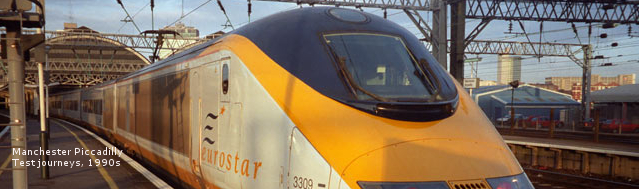
Turning back to HS2, it shows the possibility of future investment in 21 century rail. It has merit – it is less disruptive and adds more capacity than an upgrade. It connects HS1 and the Channel Tunnel to places beyond London, a promise denied in the 1990s. It does have its challenges, but truth be told, most of these revolve around what best to do with Euston. Nearly all the housing impact is within a few miles of Euston in inner London. Solve Euston and you pretty much resolve HS2.

But here we are, with another review and another rolling head.

At the risk of being old and sentimental, the 1990s settlement between Michael Heseltine and John Prescott recognised that infrastructure development requires stability far beyond the cycle of general elections and Cabinet reshuffles. Less drama, less PR, but real impact and real benefits for future generations. Hopefully it is not too late to still succeed and achieve this now.

We share our food

This week there are reports that the parent company of a newspaper had made record profits with its four directors sharing £18.3m in pay, while the journalists have not had a pay rise in eight years.

If people have become just company units, resources, commodities, then what is the point? To make ever-more money for ever-fewer people? While two life-chances pull further and further apart: the drudge on 50 hours a week, long commutes, tiny holidays, their little income lost on rent and utilities; the lucky few in cosy gated communities with lawyers and accountants to guard their off-shore treasure island.

What defines us as human, as distinctive from other primates or mammals? What was it that put us on a different path, leaving the wilderness to be fully human, to create agriculture, cities and culture? I would suggest it is our social nature that made us different – crudely, we are different because we share our food. Eating together defines and completes us. It encircles the family. It seals a deal. It marks a transition in life. Even when we could perfectly well eat alone, we are drawn to share.

The journalist Kate Adie in her autobiography The Kindness of Strangers (2002) tells the story of when she and a TV crew were filming in a town after an earthquake. They had found a woman stranded in the street with her small children, who in turn had found a few eggs and had started a fire under a flat stone to make an omelette. She had a small piece of cardboard which she used as a spatula. The crew started filming for the evening news. As they finished the woman looked up and divided the meal into two, half for her and the children, half for the TV crew. All the crew were mortified.

Today’s level of unchecked greed by a few powerful interests, with the inequality that has resulted, is basically the enemy of civilisation.

A Learning Culture

I believe that one of the quickest ways to discover the learning culture of an organisation is to examine its health and safety policy. Very quickly, this will separate out for you those organisations with a learning culture from the rest with a blame culture. 

I also believe a blame culture is bad for learning and worse, it is bad for safety.

The airline industry is a good case study here. Their health and safety policies are all based on sustaining a learning culture, and have created probably the safest working environment possible in the circumstances. Construction kills far more people than does aviation.

The culture in the aviation industry says that safety has to be systemic. You are required to share your mistakes, so that you and others can discuss them and put things right. And you will be only be disciplined if you make a mistake and do not report it. 

This is not about being nice – it is about learning. 

In aviation every near miss is recorded and discussed. Because accidents don’t just happen. Accidents are an escalation of one near miss after another until the last one hits. Like swiss cheese when all the holes combine to line up and you can see through. Each near miss was an opportunity to break that escalation pathway, and that is the way to avoid accidents. 

Not surprisingly, human error is a major factor. There are interesting and thoughtful books on this, but one example to consider here relates to team work. 

A passenger plane takes off from an airport in the Midlands and quickly the captain sees a warning light. There is a fire in one of the two engines. Not to worry, it can fly on one engine if needed. They practice this routine regularly. The captain tells the cabin crew team and switches off the engine. Only, there is a wiring fault in the cockpit and the wrong warning light has lit up. He doesn’t know it, but the captain has switched off the good engine, not the one on fire. The cabin crew can see this. They talk about it. Should we tell him? No, he’s busy, he knows what he is doing. But? No. Eventually the captain figured it out, but having just taken off, they were too near the ground and ran out of time. Result: sadly, a crash. Learning for others: you are all a team, not just flight deck pilots behind a door and cabin crew juniors who know their place. You are a team, you all are flying this plane. Every one of you.

From this example we can see the escalation of incidents, where each could have been controlled but wasn’t. 

It is tempting to go to blame here. The aircraft designers should fit wing mirrors so the captain can see the engines. The cabin crew should have taken a vote. The airport control tower people should have seen something. And so on. Lawyers come looking for scalps. Newspaper photographers want a face of shame for tomorrow’s front page. Politicians offer a soundbite. 

But when you speak to the families directly involved in such tragedies, they usually don’t want hollow compensation or a show trial. They want the truth, they want to know it won’t happen again, that in the future another family will not have to face what they have endured.

Heavy stuff. But even for more mundane parts of life, such as the school, the council, the supermarket, we all benefit from a mistakes learning culture. Fewer cases of food poisoning, less money wasted on unsuitable street lights, less time wasted sending people to the wrong place, fewer playground fights, less wasted paper, longer lasting pencils, and so on. Less grammatical errors.

Can we repair Europe’s economy?

There is a view of modern Western politics that says that the leaders of countries can no longer make new policy, at least not unless the people suggest it first. Basically, leaders are now boxed in by public opinion. In which case, for Europe’s future we have a problem. Leaders have become followers.

This isn’t just about the UK. Leaving the EU might actually turn out to be an easy gig. Possibly.

But a harder gig might be the Germany – Greece dynamic, and its impact on the euro rather than the EU.

It is no secret that there is a large body of German public opinion, quite right wing, that says the Greek people have been profligate and are now in a deep and long recession because they have let their debt grow too far. And any German leader who suggests forgiving Greek debt will be hounded out of office, or never elected.

Serious economists know that this explanation is about as useful as blaming the recession on feta cheese. There are basically two camps within the EU: net surplus countries like Germany and net deficit countries like Greece. EU countries with their own currency can devalue their way out of trouble. But EU countries in the euro zone have no such room to manoeuvre.

Serious politicians know about this problem too. There are two basic possibilities: leave the euro and devalue your new, independent currency. Or change the euro rule book to recycle funds between countries in the same way the Americans do between their states for the dollar zone.

But serious politicians fear the public backlash in either case, so nothing is done until public opinion changes. Meanwhile a whole country, a people, suffers.

There are historic precedents. The UK political right wing in the 1920s promoted the idea of the Gold Standard – sound money based only on gold bars in bank vaults. Attractive, at least until millions were unemployed and starving, at which points Keynes showed an alternative, that governments needed to take a lead and borrow to reduce unemployment and restart growth.

We need Keynesian measures again now, and this time these measures need to be internationally co-ordinated.

The main question now is, can Europe’s government leaders take a similar lead today? And if not, can we find a way to move public opinion in order to give our leaders the room they need to start moving?