Author Archives: Tony Baldwinson

A Funding Theme Park

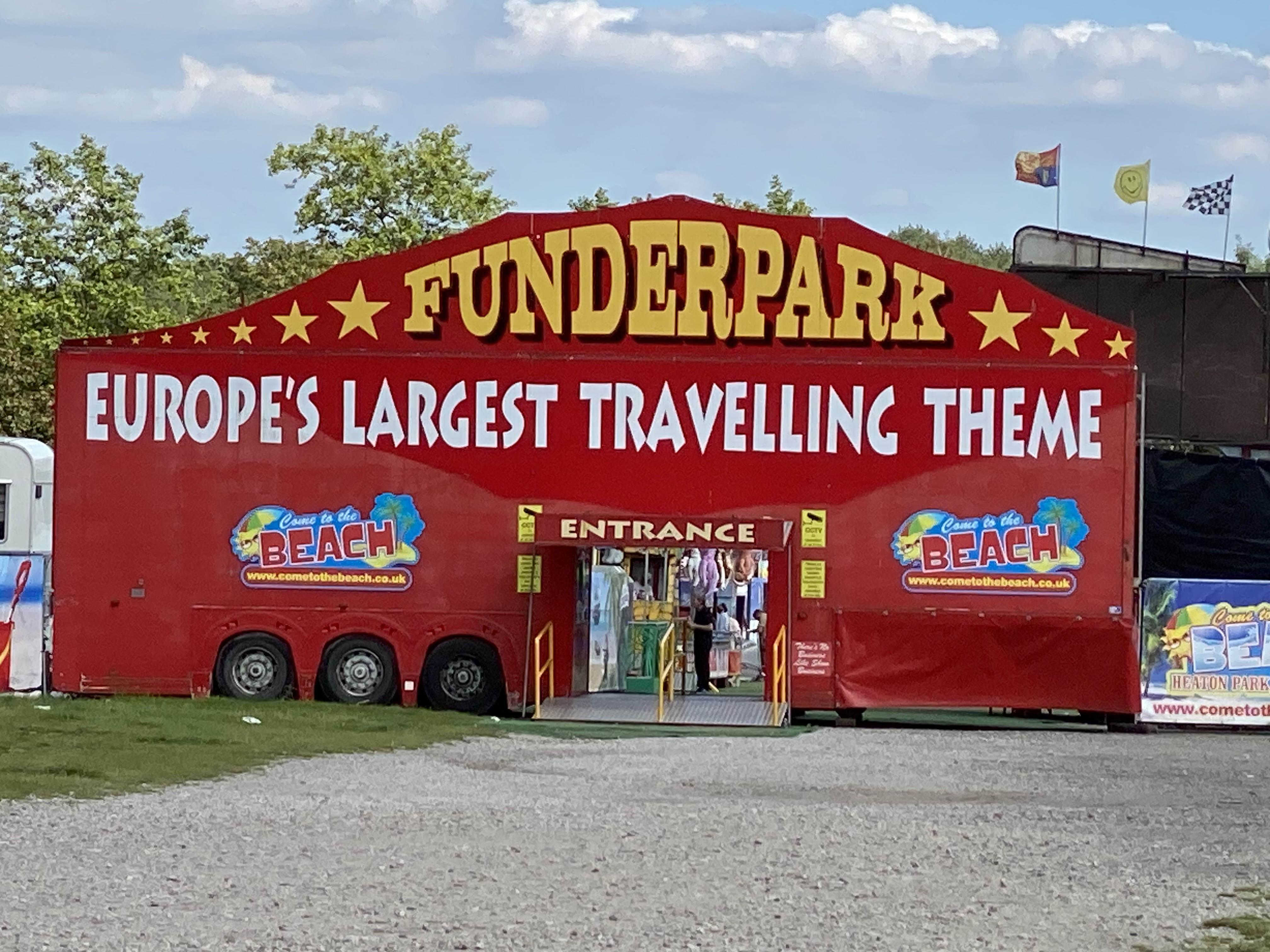
As I write there is an amusement park dedicated to funding in Heaton Park in Manchester. For my friends in the south think Hampstead Heath but better. 

Funder Park, to give the experience its proper name, has a number of thrilling experiences such as Cliffhanger (it really does!).

So, what other treats might we expect to find? Some suggestions are:

Ghost Train: travel through the darkness in search of the promised phantom replacement funding for EU grants.

Waltzer: spin your head round and round while funders change the grant conditions midway.

Carousel: sit in the same place while appearing to move forward, only to finish exactly where you started.

Coconut Shy: try to hit all the criteria off their hoops to win a prize, but too late notice you can only throw table tennis balls.

Hall of Mirrors: try to navigate a path through all the distortions required to secure funding without laughing uncontrollably at the ridiculous nature of the task. 

Roller Coaster: try to hold on to your stomach, and breakfast, while parroting the ridiculous dogma that official bodies insist on seeing in bids. 

Whack-a-Mole: need I say more? 

Welcome to the pleasure dome!

Better Planning is needed for accessible housing

The Universal Declaration of Human Rights says that there should be equal and non-discriminatory access to adequate housing.

Many disabled and older people – particularly those who use wheelchairs – cannot find a home that suits them. It is estimated that there are 14.6 million disabled people in the UK: 22% of the population. Wheelchairs are used by around 1.2 million people.

The 2016 English Housing Survey calculated that only 7% of homes are accessible.

Only 32% of planning authorities surveyed in 2018 had committed to building even a proportion of accessible housing, and only 18% to a proportion of housing built to Category 3 standard, Building Regulation M4(3).

The London and Liverpool Plans (best in class) require those authorities to ensure that 100% of new homes meet at least M4(2), Category 2 standard, with 10% at Category 3.

In July 2022 the government announced it would make Category 2 the national minimum standard for nearly all new homes.

We need to build more accessible homes and more homes accessible for wheelchair users.

We need to enforce policies in Local Plans that cover both social and private housing.

As a minimum, every new home should be suitable for disabled or older people to move into or to age in place, i.e. M4(2) standard.

• The government should commit to M4(2) as standard for all new housing.

• Local plans should be required to build 10% of new homes, social and private, to Category 3 standard.

AI, noise and possibilities

For what its worth, some thoughts on AI from someone who did a computing degree followed by a humanities masters …

Summary: after the noise and clickbait has faded, the implications for creative content makers will be ‘a flight to quality’ where brands or names will earn value by their reputations – hard won and easily lost.

My laypersons sense of AI in terms of creative content is that AI will become like ‘the channel five of the internet’ – low common denominator, time-filling, bland, forgettable. Cheap brands will use AI to make buckets of unremarkable stuff. Ask ChatGPT to write a treatment for a programme on Benny Hill – it won’t exactly inspire the awards panel.

Where AI comes into its own will be in so-called narrow applications: better speech recognition, better scans of medical images, better organising of large amounts of raw data without having to program a database. It’s been around longer than the public realise, for example in the handwriting recognition of historic documents for USA family history websites, still commercially sensitive.

And I think it will be the “new narrow” applications in the next few years that will surprise us most – there are already researchers working on AI for court hearings and decisions with the promise of no discrimination in sentencing; and on medical triage on phones before you see a GP, or in many countries, an advanced nurse with prescribing powers. Imagine uploading every scrap of paper from the Stephen Lawrence police files, and the AI summarising the weaknesses and gaps, and then for other cases in real time directing the police investigation. “AI SIO” to coin a phrase. Not impossible, AI is already passing the New York Bar Exam with consistent 80+% marks.

Or imagine a professional video editing suite where one written instruction can “remove the traffic noise from the left audio track, leave it in the right” or “add falling rain to the window pane in scene 7”.

But for now, if you just ask the internet how many types of AI are there, you will discover that there are 3, 4, 5, 7 or 9. (If it wasn’t for the ‘4’ and ‘9’ I would suspect a pattern based on prime numbers.)

Final policy point: the degree to which quality brands can protect their content from adulteration may determine their prospects. This isn’t quite the same as protecting their content from being scraped into an AI grinder. Like a hologram on a banknote to protect against forgery, it will be the digital hologram on quality content that protects value. For my money this will be done using blockchain tech as a protector of the provenance of premium content. Even of digital currencies are just a 2020s bubble-scam the underlying tech is sound.

The interesting question is which brand will become the guarantor of provenance – the creative Bank of England equivalent which will sit behind all the retail brands? As a publisher I buy unique ISBNs for ‘my’ books by the dozen, I register the details with an international database as each book emerges into the world, and Google Books etc all use this database to find fraud.

TB

On the anti-racist histories of the disabled people’s movement in Britain

There is a view that the disabled people’s movement (DPM) in Britain learnt much of its principles in the 1960s from the Black people’s civil rights movement in the USA. The difficulty we have is in finding any evidence to support this theory. To be fair, there is little surviving evidence of the DPM in the 1960s in the archives or in textbooks, so it might have been an influence.

But the evidence that does survive from the disabled people’s movement in the 1960s and 1970s does show direct links with and learning from the Anti-Apartheid Movement (AAM). The AAM was the name of a strong and progressive formal organisation of radical anti-racists, people of colour and allies, based in London.

An explanation of the focus in Britain on the AAM rather that the USA civil rights movement is perhaps best explained by the history of British colonialism, the British Empire.

Starting in the 1920s with Egypt and Guyana, by the 1950s the movements for national independence of colonised countries was unstoppable, characterised by the ‘winds of change’ speech. India and Pakistan had won their independence in the 1940s, and countries in East Africa were following – Kenya and Uganda for example – but Rhodesia and South Africa were examples of White minority rule holding out against democracy and Black majority rule. Rhodesia became Zimbabwe on liberation, but South Africa had left the British Empire following the earlier Anglo-Boer War (1899-1902) and the white minority held out the longest in resisting democracy, creating its racist Apartheid regime of oppression.

Looking at the materials that survive from the disabled people’s movement in the 1960s, we can consider the following:

1. In Paul Hunt’s journal from 1962 much of his interest is in the non-violent civil disobedience of the Campaign for Nuclear Disarmament (CND). This is the era of the Cuban missiles crisis, of the Aldermaston marches and mass rallies and arrests in Trafalgar Square. His journal does not explicitly mention the Black people’s civil rights movement.

2. In the records from the 1960s of the National Campaign for the Young Chronic Sick (NCYCS) is Mike Gerrard, an activist on its executive committee and also active on the executive committee of the AAM. The AAM archive is at the Bodleian Library in Oxford (also online) which includes a transcribed interview where he also talks briefly about NCYCS.

3. In the 1970s one of the founders of UPIAS (Union of the Physically Impaired Against Segregation) was Vic Finkelstein, a disabled man who was a political refugee from South Africa, where he had been imprisoned in the 1960s for helping Black people resist the apartheid regime. When he fled to London he was involved in the AAM first and said it was a few years later that he started to develop his political thinking around disability politics. He was at the centre of the early discussions that led to the social model of disability. He had previously been in Britain for a year in the 1960s, staying at Stoke Mandeville hospital for treatment for the first year after he broke his neck.

4. The AAM was particularly active in organising boycotts and disrupting South African sports teams that tried to play in Britain. This was mostly about rugby and cricket matches, but it also included disabled people’s sports. In particular was the demonstration by disabled people outside the Stoke Mandeville international games in 1983, and the high-profile boycott of the event by radical disabled athletes including Bernard Leach, a swimmer from the radical Manchester Disabled Athletes sports club, which made the national newspapers. The surviving documents of this event credit the work of the AAM Health Committee in helping organise and publicise the protests.

Thus, from a fragile base of evidence which needs to be further researched, the early findings show links between the disabled people’s movement and the Anti-Apartheid Movement’s struggle, as a stronger research narrative than links to the Black people’s civil rights movement in the USA.

Historical stories can be fragile. I suspect that if history had a smell, it would be popcorn. Much of our sense of our many pasts, our various heritages, and from these our shared stories of who we are, comes not from books but from Hollywood. And Hollywood narratives are not a good guide to the radical British histories.

Some further reading:

https://disability-studies.leeds.ac.uk/wp-content/uploads/sites/40/library/finkelstein-Reflections-on-the-Social-Model-of-Disability.pdf

https://disability-studies.leeds.ac.uk/wp-content/uploads/sites/40/library/finkelstein-presentn.pdf

https://tonybaldwinson.com/wp-content/uploads/2014/06/1983-05-sport-disabled-people-and-the-fight-against-apartheid-may-1983.pdf

Research Bulletin – April 2022, plus two supplements on Ukraine

Two main topics for this month’s update:

A. Disabled people in Ukraine

B. An exhibition of the history of GAD in Greenwich, London

A. Ukraine and Disabled People

Currently the European Disability Forum (EDF) is convening an online meeting each Thursday to discuss what can be done to help disabled people in Ukraine. These meetings are open to any EDF member organisation or individual members, and where recently only one person present was from the UK.

EDF is not the only organisation to respond on this issue, but it does have useful connections and suggestions. Within the UK the main coordination is by DEC, the Disasters Emergency Committee.

Currently the best information on the context is:

1. There are *at least* 40,000 disabled people in Ukraine living in institutions, some people feel the number will turn out to be "much higher".

2. There are many children in Ukraine living in orphanages, and many are expected to be disabled children.

3. Medical supplies and medical volunteers are in short supply, being sent forward from institutions to the combat areas for casualties, plus shortages with general medical supplies and difficulties getting them into the country at all.

4. Hungary has sent in some accessible mini-coaches, each one for around 8 disabled passengers, to help with ferrying evacuations.

5. Sending money remains a general priority.

6. No information yet on disability organisations in Poland and the strains on them receiving displaced disabled people from Ukraine.

NEXT MEETING: Ukraine War and Work of the UN agencies

EDF 28 April, 12 – 1:30 CET (11am – 12.30pm UK time)

"Following the outbreak of the war in Ukraine, the European Disability Forum (EDF) is hosting a sequence of short webinars about specific topics relevant to the war and their impact on persons with disabilities. These meetings are for EDF members. The fourth meeting will focus on “the work of the UN agencies”.

Speakers from various agencies (OHCHR, UNICEF, PRPD and IOM) will present their work in Ukraine. It will be an opportunity to ask questions, learn more about their coordination mechanisms and exchange contact information."

B. Greenwich Association of Disabled People – GAD, and its sister org Metro.

I was honoured to be invited to the recent launch of a Metro-GAD exhibition on the history of GAD, and the a PDF file is available with a series of rough photographs of the exhibit panels, photos, t-shirts and objects on display.

It is a modest exhibition, being in the corridor of their offices, with photos, panels, t-shirts etc hung on the wall plus a few objects on display. Some people will recognise the photo of Brenda Hilditch, and the work of Alison Blake, both of this parish.

Three posters were of particular interest – these posters are from a project Sue Elsegood, Steve Gray and April Bird were involved in 1998 – 2001. There is also a fourth poster but there wasn’t room to include it. The project was with the Brook Advisory organisation, specific to London, though for example the mum and daughter who agreed to be photographed were living in Wales at the time.

The building is opposite the Woolwich Arsenal bus and train station in south London, but as a working office with security doors people are asked to contact beforehand if planning to visit the exhibition.

Cheers all

Tony

***

SUPPLEMENT ONE:

Dear all,

Headline is: an estimated 100,000 disabled children living in institutions in Ukraine; plus an unknown number of disabled adults.

Details: this is an update on the Research Bulletin two days ago, based on messages received since then, with thanks:

1. An additional meeting on Disabled Children in Ukraine, Thurs 5 May (details below). “It is rather astonishing that there are supposed to be 100,000 disabled children [living] in institutions in the Ukraine before the war! Goodness knows where they are now and what shape they are in?”

2. “The organisation from Hungary is saying they transport people in their accessible vans, and then take them to institutions in Hungary and also neighbouring countries. This is at the instruction of the Government. [We asked if] there’s any way people could be taken to Scandinavia. But [name] just wrote that people are [being] placed in nursing homes even in Sweden!”

3. “On the number of people in institutions, there is … no [exact] number for adults, but there are many, many institutions [in Ukraine]. Also, children graduate from children’s institutions into adult ones. … most [disability] organisations are parent [-led] ones and [not DPOs].

***

SUPPLEMENT TWO:

Some further information on disabled children and adults in and leaving Ukraine:

Bear in mind this is second-hand reporting, and thanks to my contacts.

The main focus for international agencies is on unaccompanied children, including unaccompanied disabled children.

From reports in Poland, around 1 in 8 displaced persons are disabled people (all ages). This very probably includes frail elderly people.

The effort is on trying to build international standards, so there can be consistency and portability for displaced disabled people (ie adults and children) as they move between countries.

Slovakia has a good system for their child protection services knowing children’s needs, and this may be replicated in nearby countries. By contrast, in Ukraine reportedly only 1% of disabled children were registered with the authorities.

Many of the displaced disabled people (all ages) are moving currently into Germany and Poland.

As the war started, a Refugee Response Plan was developed in March 2022 by various international agencies, with a "small chapter" on disabled refugees.

"BLUE DOT" Hubs

There are (it seems from reports) 19 BLUE DOT or hub locations currently, and a total of 31 is planned for, where displaced people can get information, support and services. These include assessment and referral, mental health support, legal aid, counselling, restoring family links, child and family-friendly spaces.

There are also some LIGHT BLUE DOT hubs planned which will have a smaller number of services, and work is underway to develop a DIGITAL BLUE DOT version.

From experience so far in Poland, about 1 in 8 of the displaced people passing through and registering with their Blue Dots hubs are disabled people (all ages).

Disabled people are being prioritised for air transport evacuation from Moldova to other EU countries, so far about 1,000 disabled people.

In terms of disabled people’s needs and common standards, the Blue Dot hubs are using the "Washington Group Questions" as their common system to describe the needs of disabled people, on the basis that every country can make use this, avoiding the use of conflicting local schemes as disabled people move between countries.

The focus of some of the UN agencies is try to sustain the support services in-country within Ukraine for the disabled people who still live there, and for those who plan to return. This is starting with the priority on the basic needs of people in institutions. "Emergency clusters" are also planned, details are not known.

Neighbouring countries are also supporting additional services to document violations, including GBV (gender-based violence), counter-trafficking and child protection.

***

Also a frank note from me based on some emails seen between officials – it seems the international agencies are not expected much practical help from the UK agencies, but in return the UK government is being fully expected to pay significant funds in aid to international agencies to provide this support.

TB
On Disruption

I imagine that if the covid virus was a character in a film it would be played by Robert De Niro in some variant of Taxi Driver:

“Disruption?
You want disruption?!
I’ll give you disruption!!”

Back in the old days – 2019 say – disruption was a business goal, a sure-fire way to make more money.

Look at how Google had disrupted all the advertising money that used to go to newspapers. Look at how Amazon had disrupted the sales money that used to go to shops. Look at how Uber had disrupted local minicab companies. Everyone in business was looking to be the next platform, the next innovator, the next disrupter, the next stock market sensation.

Politically in the UK we could also see Brexit as the disrupter of party politics – lifelong Labour voters going Conservative; lifelong Conservative going Liberal Democrats; its waves still overturning election boats five years on.

Maybe for some people the pandemic has made them start to feel there are limits to how much disruption we can take at one time.

But maybe for some other people the pandemic has been the proverbial wake-up call, where they see major changes are urgently needed – climate emergency, biodiversity collapse, hunger, poverty – and decide that another type of disruption, or revolution if you prefer the older phrase, is now needed.

And maybe the interesting policy area is if these two groups of people could be substantially the same.

They might have had enough of the ‘old disruption’ such as declining High Streets and being unable to buy a cup of coffee without using a phone app and a credit card. And they might be eager for some ‘new disruption’ such as turning half a car park into a cycle park, or voting for ten thousand new electric buses.

What happens to groups and societies when a lack of empathy is amplified – some thoughts

We all like a good bit of drama, to have a story told well. It draws everyone in. It’s fascinating for us all to watch. Shakespeare’s Globe Theatre had its cheap standing area as well as the balconies for the richer folk. But the drama was staged – the actors use conflict to drive the story forward.

And crucially, when we leave the theatre we don’t copy the script, obviously by not killing and maiming people on our way home, but subtly by using our empathy for others in our social skills.

But today our in-built fascination with conflict and drama has been automated and monetised. Social and media companies and television production companies have employed psychologists to ‘improve’ their audience share by looking for low-cost ways to amplify conflict. By “social and media companies” I mean here those companies who cultivate very large audiences in order to sell their attention to advertisers, whether its Facebook, broadcast TV, online TV, Twitter or others with the same business model.

It’s important to say that this is not all media companies – I’d say that many companies producing video games have shown a great responsibility and service in creating safe spaces for people to explore and experience drama, minority communities and personal development. This often happens during play that is online in social groups with staffed moderation and curation of gaming communities.

But some social and media companies have deliberately used their algorithms and storylines to amplify conflict. For example, we saw in Channel Four’s programme Big Brother, when the initial high audience figures started to fall away, how the practice of “conflict casting” was used to select participants who were more likely to be antagonistic to each other. These days it is called “noisy TV” in the trade, which is meant to catch more people’s attention. Psychologists looked in particular for people who, for whatever reason, had less empathy than others. The Jeremy Kyle show also springs to mind. But so do the many ‘reality’ TV programmes with a divisive narrative, often against poorer people living on benefits.

We see the same dynamic in politics – Donald Trump shows less empathy than, for example, Michelle Obama. Boris Johnson with less empathy than, say, Ed Miliband.

But what might make great TV, might make memorable politics, might make compulsive posting online, is corrosive for society as a whole and for social groups.

Social groups are areas wider than our immediate friends and family where we learn and practice our social skills, including our empathy for people we might not fully agree with, or even strongly disagree with.

However, I wonder if the increasing pervasiveness and amplification of conflict with and indifference to the feelings of the other person, monetised by the larger social and media companies, is causing social harms at the micro level as well as at the macro level. This micro level includes most community, neighbourhood and voluntary groups, societies and associations.

Any one group can only cope with a certain amount of a lack of empathy within it before it must disintegrate and collapse as a social group. Good community development skills can mitigate this to an extent, but everything has its limits.

“We have more in common than divides us” is not just a morally good statement, it is an instruction, a commandment, we give to ourselves to protect our empathy skills against the structures that seek to undermine them for their own gain, both political and commercial.

I feel that the textbook of skills for community development needs a new chapter for the 21st century – something like – Rebuilding Empathy in Communities in the face of Social and Media Amplifications of Conflict.

Tony

Research Notes, June 2021

Somewhat Lame

I was recently encouraged to look at a computer app, Grammarly, which is popular with students looking to improve their writing skills. So, ever curious, I gave it some of my notes of a meeting to see what it might say about my style. It came back with four errors, three of which were style choices (and it was clearly wrong!) and, fair enough, one was an improvement. The software also gives the writing some overall scores, and I was given a good for style and clarity (of course!).

But the kicker was the overall judgement that my writing was “somewhat lame”. Hold my coat, we’re taking this outside chum!

I could bleat on about how committee minutes are maybe not the same as a paperback thriller story. But no, instead I’ve decided to try and up the tempo of my writing. Kerpow!

Ear to the Ground

I’m pleased to say that Anne Plumb’s book on the catalogue of her lifetime archive collection of the voices of mental health service users and survivors is working its way steadily through the drafting stage, aiming for publication in the late summer.

I continue to be struck by the humour of service users, survivors, and indeed inmates. One group of patients in a locked ward at a “special hospital” organised a sponsored bed-push as a fundraiser, and wonderfully called it, “The Great Escape”. Ker-boom!

Hulme Hippodrome

One of the nice features of being involved this year with the Save Hulme Hippodrome campaign is that there are so many very capable heritage and archive researchers already involved. And they are far better at this research lark than I am, so I’m learning lots from them. My role is more on the legal and property side, which makes a change. Splat!

Not Dead Yet UK

It seems that every five years or so some misguided politician, usually in the House of Lords, decides to take a punt and try to get Assisted Suicide (aka Assisted Dying) made legal in the UK. So, here we are again with a private members bill in the Lords doing just that. I’m doing some work in the background here. For all the campaign details please see the NDYUK website, and it’s all hands to the pumps. Wham!

What’s your app of choice?

Apparently once we reach 36 years of age we stop listening to new music. I wonder if there is something similar happening with tech. I come across younger people in various campaigns who these days use apps like Trello to help them in project management. Maybe when they too reach 36 years old they will stick with the same app they started out using? I have done so mostly, and apart from the occasional project spreadsheet I find my app of choice remains Filofax. Zap!

Keep safe, and keep campaigning,

Tony

Research Bulletin – April / May 2021

Hello again all,

Sorry for the delay in this research update from Canal-side Towers, there have been a few busy projects requiring my attention. Sometimes you can only do so much, and these definitely are such times.

The Disabled People’s Archive

One of the recent additions has been the Judy and Paul Hunt Collection. While the pandemic closures have led to a backlog of boxes here in the Towers, the upsides are that there is less carpet to keep clean, and one gets more of a preview than usual. It’s a modest but powerful collection of family papers in five boxes – and such treasures! Then I noticed that Paul Hunt (1937-1979) didn’t yet have a Wikipedia page which I felt was quite wrong, so recently I’ve made a start, based on some of these papers. Please feel free to add and correct it – anyone can, it is open source and a community creation. And many thanks to Judy Hunt for creating this new Collection.

https://en.wikipedia.org/wiki/Paul_Hunt_(disabled_activist)

Access for all, and hybrid files

This one is a bit more tech-y.

One of my recent interests has been to try and find a single format for a digital file that can be used for sharing copies of archived born-analogue papers in fully accessible manner.

At the moment we often use multiple file formats for the same record to cover different access requirements (usually as PDF and as Word). This isn’t efficient and has the risk of the multiple files about one document becoming separated, compromising their accessibility.

Previously I’ve used OCR (optical character recognition) to try to improve the accessibility of PDF copies, but the accuracy is only around 80% and this isn’t good enough. In time the quality of OCR programs and apps may improve enough, but currently another method is still needed. Born-analogue documents with columns, text boxes and other complex layouts can confuse OCR programs – except some commercial ones (eg as used by Ancestry.com to scan in old copies of city directories while skipping headers, ads, side-bars, etc).

One approach I am testing is to append the PDF document to the Word document, and save the resulting file as one, larger PDF. The Word document is usually created by starting with an OCR version then manually correcting the errors by looking at the original item. This can be called a hybrid file format.

This method works in terms of it being a single file, and for visually impaired people the navigation seems to work best when the plain (from Word) text is at the start of the file, and the imaged pages of the original document follow afterwards.

Another approach to creating a single file is to use a photographic image of each sheet of the archived paper, along with an alt-text description, then adding the plain text (from Word) into this combined, larger PDF. Happily the PDF format retains items such as alt-text descriptions of images. Whether this is an improvement on the first method currently remains to be seen.

Perhaps one of the long-term solutions will be made possible by the screen-reading programs such as JAWS that now sometimes include their own OCR function. However, having a good copy of the digital text already embedded within each file does also help with the search function used as a finding aid by archivists and researchers, and by search engines.

One current drawback with using PDFs for these hybrid files is that JAWS requires the reader to manually command a next-page at every step to read the full PDF, in comparison with Word where JAWS will ignore page breaks and read it out continuously (thanks Linda for pointing this out).

All comments and pointers gratefully received,

Keep staying safe,

Tony

PS – some people may find this of interest:

2020-08-01 CAT – Campaign for Accessible Transport – 1989 and 1990 (Draft v1)