Author Archives: Tony Baldwinson

Explaining where the public debts have come from, and why they were needed

We don’t like to remember the difficult moments – neither personally and politically.

Many of us will know the older person who comes out of hospital after a major heart attack and heads straight for a cigarette in the doorway of their local pub, “I dodged a bullet there.”

And politically.

Many UK political decisions are constrained by talk about huge debts and “balancing the books.”

But in analysing the 2010 election and the ‘need’ for austerity we forgot about having to pay for the 2007-08 financial crash; and now in the 2024 election we forget about having to pay for the 2019-22 pandemic with its loans and grants as well as things like the notorious PPE contracts.

One factor here is that politicians in opposition during an election have learnt that there are more votes in blaming the other guy rather than in explaining why the increase in debt happened.

And politicians in power see no benefit in building up reserves ‘for a rainy day’ so when the crash, pandemic, crisis … arrives we will always be fiscally unprepared.

In terms of healthcare, it also means we (as a country) don’t want to talk about long covid, nor why we have so few intensive care units compared with other countries.

Dodging bullets is a curious human trait, but no way to properly run a country.

“Talent is everywhere, but opportunity is not” has its roots in feminism

From my research, the phrase talent is everywhere, but opportunity is not was possibly first made popular by a book and a documentary film concerning women’s rights across the world.

The film was released in 2012 and the book with same short title was published in 2009.

The authors of the book were involved in making the film and the book included the following text, later reworded within the film to make the phrase:

“The main factor that separates me [said Harper McConnell, USA] from my friends here [in west Africa] is the opportunities I was given as a first-world citizen, and I believe it is my responsibility to work so that these opportunities are available to all.” (Kristof and WuDunn, 2009, p103)

References

Kristof, Nicholas D., and Sheryl WuDunn. 2009. Half the Sky: Turning Oppression into Opportunity for Women Worldwide. [book published by] New York: Alfred A. Knopf / Vintage.

Half the Sky. 2012. [documentary film, 3h44m] written by Michelle Ferrari, directed by Maro Chermayeff, with this phrase spoken by Nicholas Kristof.
https://www.imdb.com/title/tt2193091

What will “work pays” mean in 2024?

This note follows the conference speech by the Chancellor on 23 September 2024 concerning the new government’s ideas around “making work pay” in advance of the October Budget, and the possible implications for DWP and disabled people.

I am suggesting that some rapid thinking and lobbying might need to be done ahead of the Budget, for the following reasons.

Background

In the 1990s the policy of the New Labour government was that “work pays” and the thinking was that – being in work brings all manner of additional wellbeing benefits to a person and their family in terms of better health, better educational achievements for their children, and more dignity and social cohesion. The argument was that unemployment benefits had been considered to be “a price worth paying” by the Thatcher governments in the 1980s in order to crush trades unions and deindustrialise the UK, and where sympathetic GPs signed off unemployed people as sick because the benefit payments were higher. The darker side of work was glossed over in this 1990s policy: the pressures, the fatigue, the loss of autonomy, and frankly the obligation to spend your time with some colleagues who could be quite obnoxious at times, certainly not people you would invite into your home. For many people there was also the experiences of workplace bullying, discrimination and harassment, or worse.

Into the 2000s the “work pays” details were probably best shown in practice in the New Labour government’s New Deal for Disabled People, and in the generous Child Tax Credits used to reimburse working parents for additional costs.

In the 2010s with the Conservative Coalition government and austerity cuts, the “work pays” philosophy was twisted so that in-work benefits became a lifeline to support people in low paid and insecure employment, basically the state was subsidising cheap labour. Reportedly 70% of benefit payments were to people in low paid work, only 30% of benefits went to unemployed people. The tax credits were savagely removed and later replaced with the two-child benefit cap. Alongside this was a hostile environment for people on out-of-work benefits to drive them into the labour market. This DWP’s hostile environment and the resulting hundreds (at least) of documented additional deaths are investigated and detailed in the recent book The Department by John Pring.

So far in the 2020s we have seen what some people have called The Great Resignation in 2022 following the pandemic when reportedly over 400,000 people below the retirement age left the UK labour market. There is speculation about the reasons for this, probably being a collection of factors including disillusionment with corporate office work and relentless miserable commuting, mental health issues which were created by or increased by lockdowns and isolation, and possibly realising the futility of working with pre-school age children in the family where all the disposable income is consumed by extra childcare costs.

Possible changes ahead

So, on the positive side it might be the intention of the 2020s version of “work pays” that by increasing the minimum wage and removing insecurity such as zero-hours contracts, the state is wanting to reduce its subsidy of in-work benefits to cheap labour employers without reducing the money that working people receive. Pre-school state childcare could also see a revival, and many campaigners want to see the return of Sure Start everywhere.

However, on the negative side it might be that the hostile “push” will continue to drive non-working people back into the labour market. This could be explained or justified by a reprise of the 1990s New Labour thinking around the claimed wider personal and social benefits of being in work, almost a social justice argument about the dignity and personal growth from being in work. Thus, the great resignation around mental health pressures will be tackled by arguments that, such people would thrive better in work if only they could understand what is happening to them, and therefore it is a great kindness by the state, indeed a moral obligation, to drop them back into work even though they don’t yet realise it is for their own good.

We can imagine now, for example, that the NHS 111 algorithm for people contacting with a mental health concern might well be pasted into the DWP algorithm for pushing people who are signed off sick with mental health issues back into work, it will be claimed with “support” such as cheap and scalable online CBT. We will be told it is “win-win” for people’s wellbeing and economic growth.

Conclusion

But until the documented additional deaths have been fully investigated and understood, there is a grave risk that the swooping rhetoric of “win-win” will be matched by a reality of further harm and fatalities.

A general election – will third sector funding turn a corner?

Problems in obtaining funding has been a common issue for NGOs over many years, but 2024 feels to be one of the harshest times in living memory.

Every organisation will have its own specifics, but there is a shared funding environment of

  • general public sector austerity since 2010
  • local authorities drastically reducing grant giving
  • high inflation, especially in basics like fuel, and
  • very high inflation in building repairs.

There is also a shared environment of rising poverty and demand for basic living needs due to rising inequalities. Where we used to read about poverty we now have reports of destitution.

There have also be disappointments / broken promises / bad faith; for example when we were told the billions of EU structural funds would be replaced in full by new UK funds. Who remembers the Shared Prosperity Fund, anyone? These disappointment (or worse, you choose) were linked to the policy failures in Levelling Up, not least when so many of the pre-existing ‘levelling up’ community and regeneration funding streams had been scrapped by 2012.

With a general election now underway the lobbying in the arts, heritage, and social welfare sectors will be intense. One suspects that nervous parties will not want to make funding commitments for deep fear of being seen as economically incompetent by hostile media.

Looking back to 1997, the Labour Party manifesto promised to match the Conservative Party’s financial plans for the first two years in government. This turned out to be quite a canny pledge. Once in government the overall spending limit was maintained, but what it was spent on changed quite radically and quite quickly. There was also the Private Finance Initiative, a flawed funding mechanism as it turned out, but it rapidly built lots of new hospitals and schools.

But this time the sums will probably be harder to balance because the levels of need and neglect are so much deeper, and PFI is off the table.

Which probably leads us to the need to rebalance taxes – who pays more, and how much. My guess is that manifesto promises will be limited, along the lines of “no more taxes for working people” which should leave enough wiggle room; plus linking tax to need, such as taxing unearned income to pay for removing the two-child benefits cap.

So for third sector organisations this political nervousness will probably lead to a lobbying strategy of – fingers crossed.

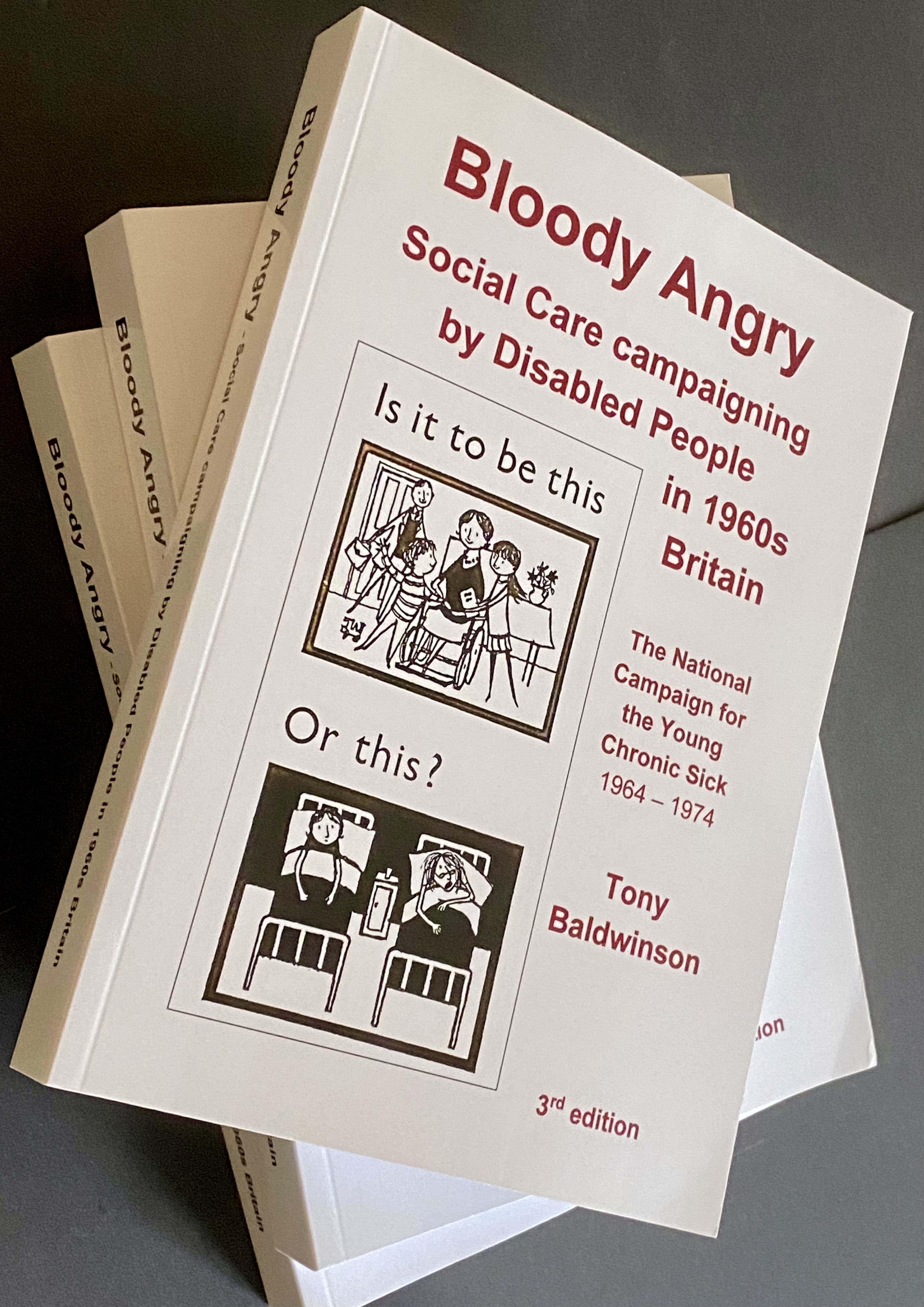
Bloody Angry – new research on social care campaigning by disabled people

This new book is the third edition of research into NCYCS – the National Campaign for the Young Chronic Sick – and it extends previous research in the 1960s with new material from the 1970s, plus some new material on the people involved.

As usual, free online with a Creative Commons licence to freely make non-commercial copies.

Key Distraction Indicators

In his book, The Tyranny of Metrics (2018), Jerry Muller offers a critical analysis of the overuse of KPIs across a range of public and commercial sectors. Chapter 1 gives a summary of the this analysis and the book as a whole covers examples from policing, healthcare and transportation; as well as commercial examples of the misuse of KPIs.

Perhaps the obvious conclusion is that an obsession with KPIs crowds out any qualitative evidence of the positive and maybe negative impacts of a project, process or intervention.

But equally important is that KPIs-only has a feedback on which types of people become to be seen as effective managers, and it isn’t a good story. Muller shows that relying on KPIs alone to determine effectiveness tends to drive out managers who show creativity and talent, and promotes unhealthy gaming behaviours instead.

He doesn’t say that KPIs have no place at all, but they are not the predominant sign of excellence or effectiveness.

Public services and moral injury

The idea of moral injury is perhaps best known in the health sector, naming the longterm stress that impacts on dedicated staff who are unable to respond to the distress of people they meet because of a poverty of resources.

But we are now seeing moral injury across many public services:
– schools arranging counselling for teachers no longer able to refer vulnerable children to social services;
– police officers attending serious incidents involving people and addresses where warning signs have previously had to be skipped over;
– housing officers unable to find a home anywhere for a family, even with young children.

Some right-wing politicians talk about the merits of the small state. This is usually linked to lectures about productivity in the public sector.

Productivity here isn’t what it usually means – companies buying the latest equipment so that people can do their best work – instead of investment these politicians are talking in code about fewer staff and lower wages.

In economics, reducing the revenue available, not increasing the capital invested. All to make room for tax cuts for wealthier people.

Where does this road lead to? I’d suggest it leads to burnout, followed by workforce exodus, leading to service collapse, and usually a public scandal but blaming an individual (usually a female manager, especially in the tabloids) instead of questioning the paymasters.

As with the breakthrough scandal of the Post Office, we paradoxically need more public scandals to save public services.

Social Care Assistants ?

The conflicted world of medical and social care:

It seems the use of “PA” for Personal Assistant may become a source of confusion as medics are increasingly using PA now for Physician Associate, for example in social media posts.

Interestingly, office workplaces have already started to use “EA” and Executive Assistant instead of PA to avoid confusion in recruiting staff.

I guess the pressure will be to rename PAs as Care Assistants; probably accompanied by pressure to align CAs with Health Care Assistants, HCAs in hospitals. Or maybe SCAs, Social Care Assistants, as a parallel career to HCAs.

Disabled people with Personal Health Budgets are already seeing their PAs being tasked as if they were community-based HCAs, with all the medicalisation that implies.

Manchester to Paris Night Trains

EXTRACT, full report below:

Looking at this from Manchester, the announcement by the UK Prime Minister Rishi Sunak cancelling the HS2 programme north of Birmingham had echoes of the previous ‘pausing’ of the Regional Eurostar services from Manchester to Paris in 1999 to accommodate the rail privatisations by John Major started in 1993.

Before HS2 became a programme, around 2007 I started working on a pro bono rail regeneration project to show how trains could run between Manchester and Paris. In 2012 the detailed report was first published showing it was possible. 

But UK rail decisions are a tough mix of complex engineering and raw politics. 

The 15-year cross-party national consensus on a major project such as HS2 is maybe a bigger loss to the UK. Ever optimistic, this 2nd edition of the report is an attempt to keep the flame alive for a timely improvement in the rail connectivity of Manchester; and to provide a model for cities in the north and south-west of England, and in Scotland and Wales, just as Regional Eurostar did.

This report shows just one solution. It isn’t the only one, and good project management always requires adjustment as the conditions change, in order to continue to achieve the original goals. Therefore I haven’t updated 40 pages of technical details from 2012 – the point is that the case is shown to be viable, and a full professional team will certainly find a better mix of engineering than this for the 2020s.

But all this begs the question, is the project politically viable?

In writing this report I consulted widely with politicians, with the commercial directors of train operating companies, and with rail experts while writing the report. Politically, the support was always warmer the further north I went.

By contrast, there was genuinely warm and help both north and south from within the industry itself. Even from some of the companies who would be facing new competition. If it is invidious to name just one person, I want to record here that John Nelson was very kind to this project and he made time to come to lunch in Manchester to cover the details. 

The two main strategic changes since the first edition are the growing popularity and frequency of night trains between the major cities on continental Europe, and the 2021 Williams Review in the UK which effectively ended the franchise model of privatisation and replaced it with paying for arms-length management.

For discussion of options involving Birmingham, please see pages 8, 24, 27, 35 and 37 of the full report on this website (free).

If I have one observation to share here it is that the ‘business case’ mantra of
HM Treasury has become just politics pretending to be maths. 

And if I have one hope to share from this project it is that some seeds do grow. I said at the top that the Regional Eurostar project was just ‘paused’ so I like to think there is a possibility above 0% that it can still be delivered.

For current contextual details, the page – https://en.wikipedia.org/wiki/Regional_Eurostar – provides a fair account with credible sources.

This is the full report, 44 pages: