After the previous government scrapped plans for the HS2 railway to go north of Birmingham, the current government has recently announced that it will look at new plans to reinstate a Manchester-Birmingham leg which would cost less, plans which the transport secretary Louise Haigh MP called “perfectly viable”. (Financial Times, 9 Nov). A decision is said to be due in Spring 2025.
The moniker HS3 is already earmarked for the transpennine Liverpool-Manchester-Leeds-Hull upgrade, much overdue, so perhaps the Manchester-Birmingham leg will be known as HS4.
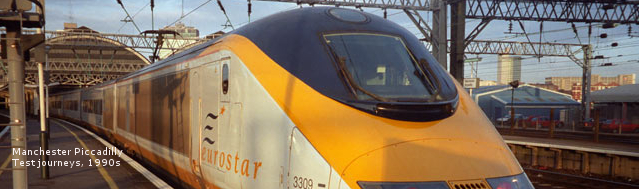
Twelve years ago I published a pro bono business plan to show how a Manchester-Paris train service could be achieved using existing rail systems and trains in use. I still believe this is possible, and with some careful planning the proposed HS4 Manchester-Birmingham leg can play its part.
The key issue remains the three different signalling systems, which are:
- HS1 – this uses the French TVM-430 system (in cab).
- HS2 – this will use the European Train Control System (ETCS) at Level 2 (in cab).
- HS3 and HS4 – these will need to be ETCS for ease of through services.
- Conventional Rail – this uses trackside visual signalling (outside cab).
As well as the signalling system for HS4, the other significant design choices are maximum running speed, and whether to rely on tilting trains or not. Once these design choices are known, the trains can be ordered or modified.
I would add a further consideration, that the trains should be built to be compatible with Channel Tunnel safety rules, especially if these align with UK safety rules for high-speed tunnels.
A good decision has been announced in the recent Budget to extend HS2 by tunnels in north London from Old Oak Common to terminate at Euston, but the connection to HS1 at St Pancras still means using local conventional rail near to the two stations, probably the busy North London Line (aka London Overground).
Whether there is enough political capital available for the tunnels to run on to St Pancras is for another day, but it would open the UK outside of London to international rail services in a more sensible way. The design at St Pancras should be for through platforms to run on to HS1 and to the Channel Tunnel, not terminus platforms.
In railways it seems the political maxim remains true, we eventually do the right thing, after exhausting all other options. (Abba Eban, 1967, but often mis-attributed to Churchill)
 Tony Baldwinson